A creature is not a fixed symbol
An animal on a helmet, breastplate or shield may catch the eye before any other detail. It is tempting to treat it as a code: a lion means courage, an eagle means power, a dragon means danger. Those associations can be useful starting points, but none is a universal translation. The same creature could refer to a family emblem, a ruler, a religious story, a local tradition or simply a design admired by the person who commissioned the object.
Meaning also depends on who was expected to see the armour. A device intended to identify its wearer at a public event served a different purpose from decoration on a piece kept in a ceremonial setting. Some motifs were legible to a broad audience; others may have depended on knowledge shared by a household or community. When that knowledge has not survived, the most careful interpretation is sometimes an open question.
Lions and eagles: familiar forms, varied messages
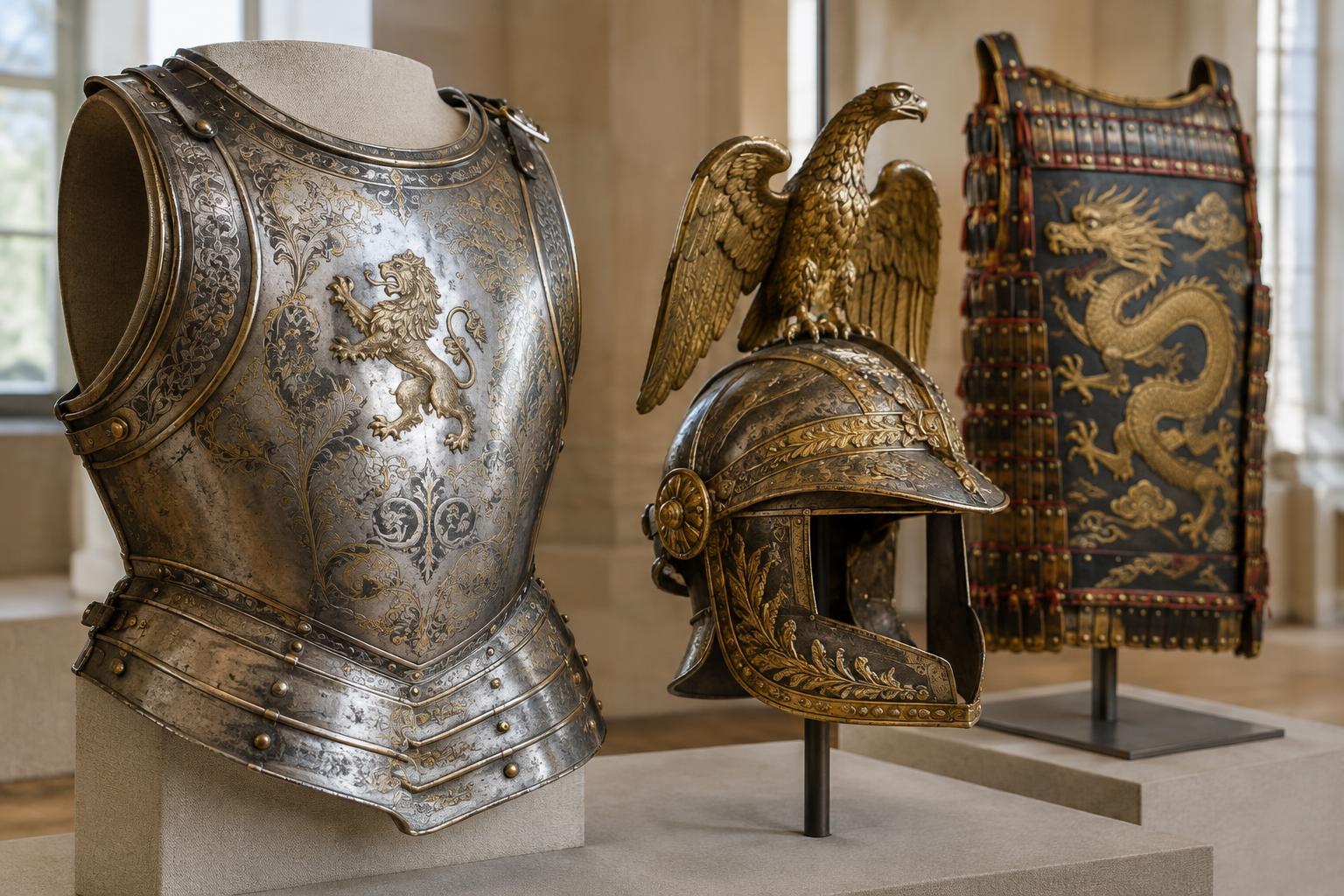
Lions have long offered artists a striking image of strength and authority. Yet a lion on armour need not be a general statement about bravery. In European heraldic settings, its pose, colour and placement could make it part of a particular coat of arms. Elsewhere, lion imagery might evoke guardianship, royal standing or an established decorative tradition. Two lions that look similar to a modern viewer may have belonged to quite different systems of meaning.
Eagles invite the same caution. Their height of flight and commanding appearance make them suitable emblems of power, but an eagle can also be tied to a specific political identity, family device or religious association. Details matter: a single- or double-headed eagle, the objects it holds and the surrounding imagery can all change the reading. Even then, a motif may carry several associations at once. Identifying one possible meaning does not necessarily exclude the others.
Why dragons resist simple comparisons
Dragons show the risks of applying one tradition’s symbolism to another. In some European stories and images, a dragon appears as an adversary overcome by a heroic or holy figure. In various East Asian traditions, dragon imagery can instead suggest auspicious power, authority or a relationship with the natural world. These are broad patterns, not rules governing every object made in either region.
The form of a dragon matters as much as its name. An animal-like ornament identified as a dragon today may have had a more specific identity to its original makers and viewers. Its companions, position and style can offer clues: a dragon set within a larger narrative is not necessarily doing the same work as one repeated across a decorative surface. Reading either as simply “good” or “evil” would flatten the object’s history.
Armour was made to be seen in particular settings
The place of a motif on armour affects how it communicates. An animal placed prominently on a shield or helmet could help establish identity at a distance. One worked into a border or fitting might reward closer inspection and demonstrate a craftsperson’s skill. Motifs on horse armour could extend a visual programme beyond the wearer, making a person and mount appear as a coordinated display.
Materials and techniques shape that display. A creature formed in relief creates a different impression from one engraved into metal or expressed through contrasting surfaces. Repetition can turn an emblem into a pattern, while a single large figure demands attention as a focal point. These choices may reflect taste, available craftsmanship and the intended occasion as well as symbolic purpose. Decoration is evidence of how an object was designed to appear, but it does not, by itself, prove how every audience understood it.
How to read a motif without overreading it
Begin with what can be observed. Which animal is shown, and how confidently can it be identified? Note its pose, scale, location, surrounding figures and relationship to other decorated parts. Then consider what is known about the armour’s place and period of manufacture, its possible wearer and any later alterations. A museum label may distinguish between a documented identification and a proposed interpretation; that distinction is valuable.
Finally, leave room for change over time. Armour can be inherited, modified, displayed in new settings or separated from related pieces. An animal motif that once marked a particular identity may later be appreciated chiefly for its workmanship. Looking closely at both the object and its history does not diminish its symbolism. It reveals why a familiar creature can carry more than one meaning—and why some meanings remain uncertain.