Why an edge deserves a closer look
A plate of armour does not end where its broad surface ends. Its margins meet clothing, neighbouring plates and the wearer’s body. Some are left relatively plain; others are folded, rolled or finished with a separate border. These details can change how a piece feels, looks and holds its shape. They also offer a useful place to begin looking at craftsmanship, because an edge often shows how a maker resolved the transition between a protective surface and everything around it.
Context matters. The lower edge of a breastplate has a different relationship to the body than the edge of a shoulder plate that overlaps another moving part. A border made prominent on a display surface may also serve a visual purpose that a concealed margin does not. Rather than treating every finished edge as the same feature, ask where it sits, what it meets and whether similar edges appear elsewhere on the object.
Rolled rims and practical choices
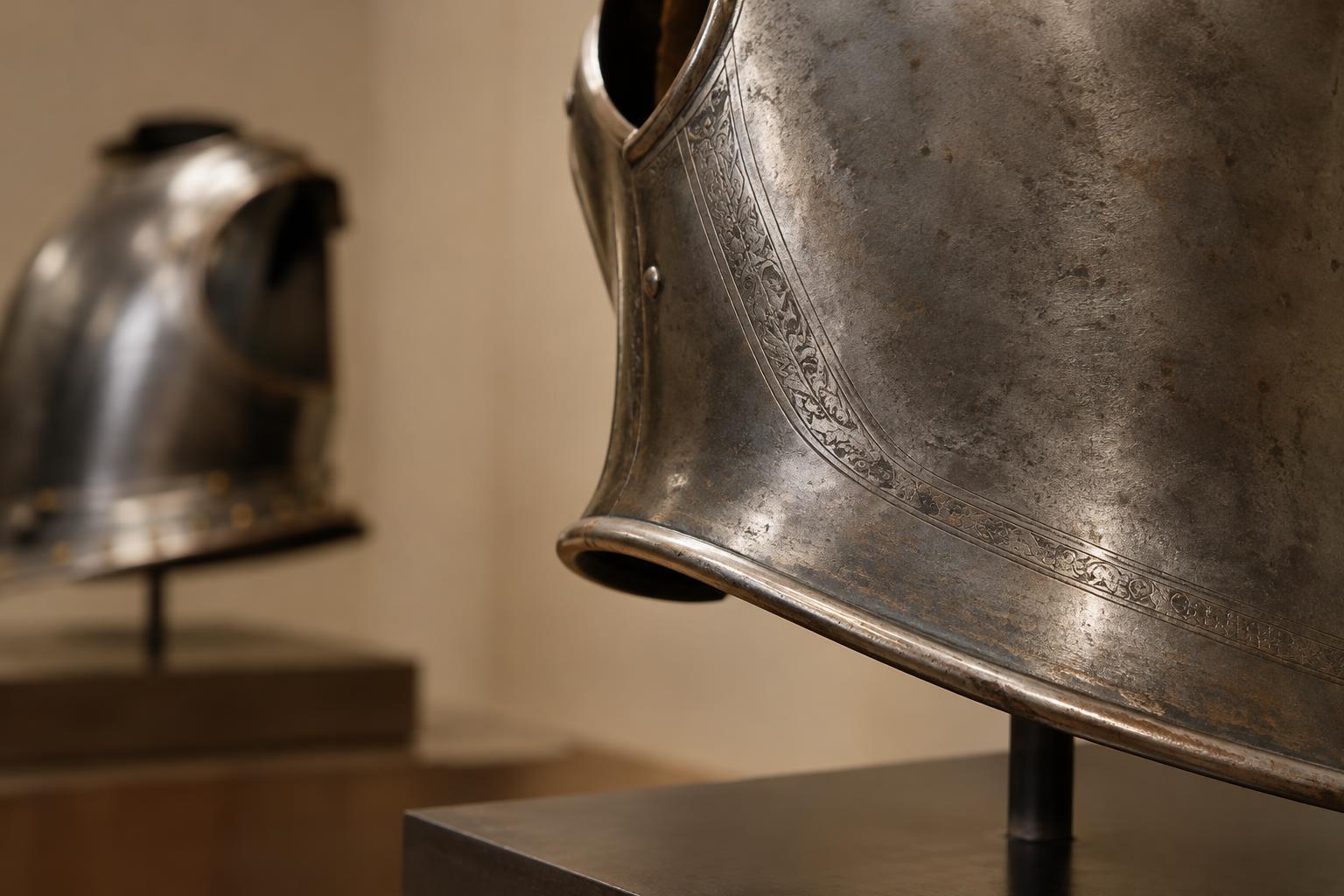
Turning a sheet-metal edge back on itself can create a rounded rim. A roll may give a margin a smoother profile, reduce the exposure of a thin cut edge and make that part of the plate more resistant to bending. Its effect depends on the plate’s shape and thickness and on how the rim was formed. A heavy-looking roll is therefore not, by itself, a measure of how well an entire piece of armour would perform.
Not every border is a simple roll. A margin may be folded tightly, raised into a ridge or finished with a separately attached strip. What looks alike from the front may differ at the back. On some objects, the changing width or depth of a rim reflects the space available around joints and openings. Looking at the edge in relation to nearby hinges, fastenings and overlapping plates is more informative than identifying its profile in isolation.
Borders as visual design
Edges also frame armour. A plain surface can appear more deliberate when its openings and outlines are consistently finished. Rims may carry grooves, ridges or other decoration that repeats across several pieces, drawing the eye from a breastplate to the arms or helmet. Such repetition can help an ensemble look unified, even when the individual plates have different shapes and jobs.
A matching border does not necessarily mean that every plate was made at the same time or in the same workshop. Pieces could be altered, replaced or assembled together later. Nor does elaborate finishing automatically identify a particular owner or occasion. The safest reading begins with what can be seen: which motifs repeat, where they stop and whether the finish continues around areas normally hidden from view. Those observations provide questions to investigate, not an instant history of the object.
What wear, repairs and displays can obscure
Edges are vulnerable to changes made during an object’s working life and afterwards. A damaged margin might be trimmed or repaired; a replacement plate might receive a border intended to harmonise with older pieces. Corrosion can soften a crisp profile, while cleaning and restoration may affect how its surface appears today. These possibilities do not make the border useless as evidence. They make it important to compare the edge with adjacent metal, attachments and signs of alteration.
Museum presentation can shape what visitors notice. A mounted suit may appear to have continuous, matching borders, although some of its most revealing margins face inward or sit beneath another plate. Photographs can flatten a raised rim or conceal the back of a fold. When an exhibition provides multiple views, use them to compare front and reverse rather than relying on a single silhouette. Respect any barriers or handling rules: close observation need not involve touching the object.
The most productive question is rarely “What does this edge prove?” It is “What choice does this edge appear to record?” Its shape may suggest attention to stiffness, comfort or visual rhythm, while its condition may point toward later change. Read alongside the rest of the object, a modest border becomes part of a larger account of making, using and preserving armour.