Start with the object, not a universal symbol
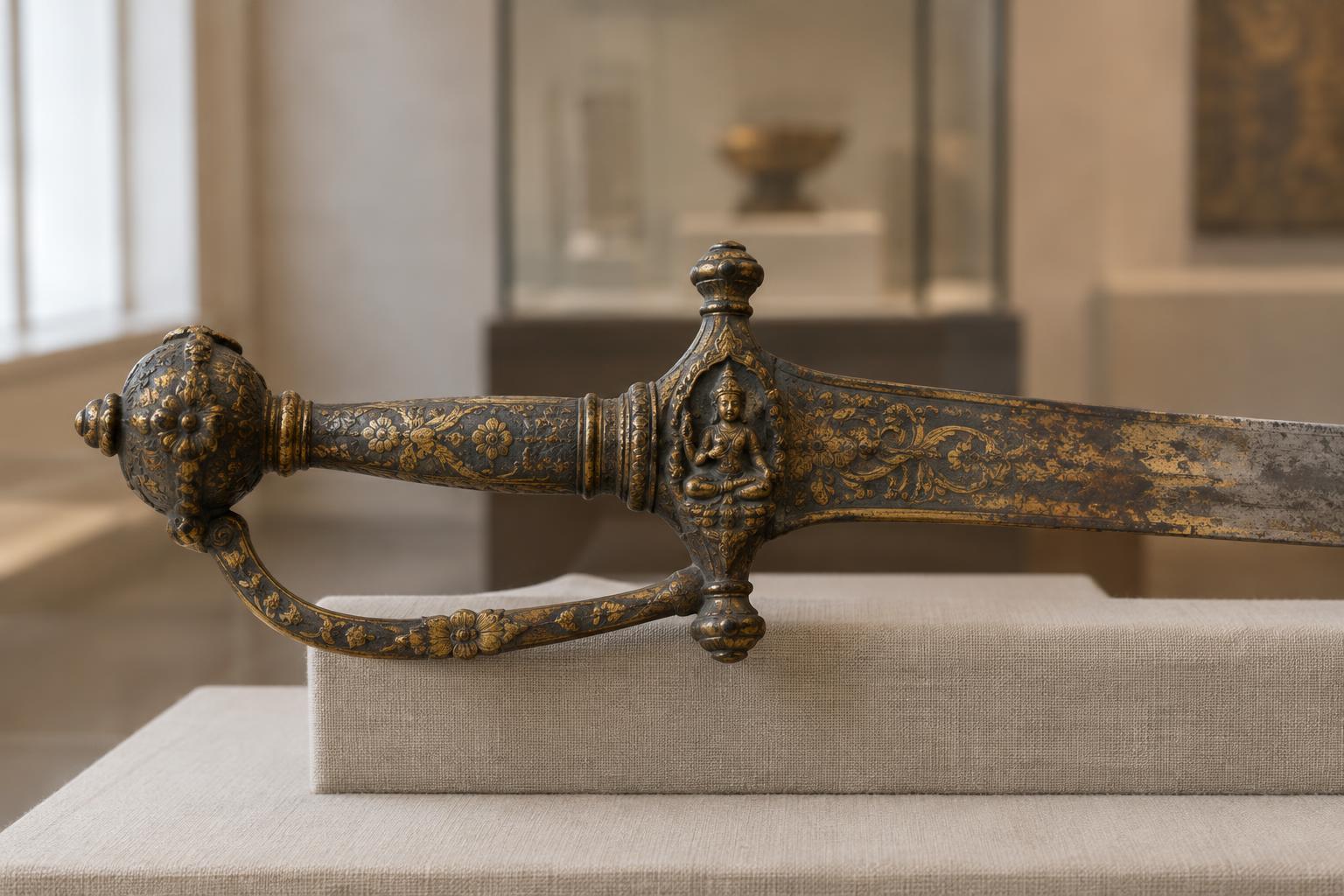
A figure engraved on a sword hilt or worked into a shield may invite a quick identification: a deity, and therefore a statement of its owner’s faith. Identification can be a useful first step, but it is not a complete interpretation. South Asia encompasses many languages, religious traditions, courts and workshops. The meaning of an image could vary with its place of production, the person who commissioned it and the setting in which the object was displayed.
Begin by describing what can be seen. Is the figure part of the original metalwork, a later inlay or an element added during repair? Does it occupy a prominent position, or sit among floral ornament, inscriptions and other figures? The image’s scale and placement can tell us how it was presented, even when they cannot tell us exactly what every viewer understood it to mean.
Recognition is not the same as interpretation
Attributes can help identify a figure. A recognizable animal companion, gesture or object may point toward a particular deity, while an inscription can sometimes make an identification more secure. Wear, stylization and regional artistic conventions can also make a figure difficult to read. If the evidence is incomplete, “possibly depicting” is more honest than an unqualified label.
Even a confident identification does not establish a single purpose. An image might express personal devotion, invoke protection, honor a patron’s preferred imagery or draw on an established decorative vocabulary. It might serve several of these purposes at once. A deity shown on an arm does not, by itself, prove that the object was used in a religious ceremony, belonged to a particular community or carried the same significance throughout its history.
Patronage brings more than one person into the picture
Historic arms were rarely the work of one person alone. A patron might commission an object, while a craftsperson shaped its materials and another specialist supplied engraving or inlay. A workshop could repeat a successful design for different customers. Imagery may therefore reflect a patron’s wishes, a maker’s repertoire or a combination of both. Without documentation, it is difficult to assign every design choice to an owner.
An object could also pass between households, be offered as a gift or enter a collection long after it was made. Those later relationships matter. An image meaningful to its first patron might be read differently by a subsequent owner or museum visitor. Rather than treating patronage as a direct line from symbol to identity, it is more useful to ask who selected the imagery, who encountered it and what evidence survives for each answer.
Look for relationships across the whole design
Deity imagery should be read alongside the object’s other features. Inscriptions, emblems, animals and decorative borders may help place a figure within a broader visual program. Materials and techniques can reveal where the maker devoted particular attention. Comparable objects may suggest that a motif belonged to a workshop tradition, although resemblance alone cannot establish a shared maker or owner.
Mixed visual vocabularies deserve particular care. Religious imagery and styles associated with different communities could appear within the same wider culture of craftsmanship and patronage. Their coexistence need not be explained away as a contradiction, nor treated as proof of a tidy story about tolerance or identity. The object may preserve evidence of exchange while leaving the circumstances of that exchange uncertain.
Describe uncertainty as part of the history
A museum label or collection record works best when it separates observation from inference. It can identify a figure where the details support that identification, explain where the image appears and state what is known about provenance. It can then offer possible interpretations without presenting them as documented intent. If a date, owner or place of manufacture rests mainly on stylistic comparison, that limitation is worth making clear.
Respectful interpretation also recognizes that a deity may remain sacred to visitors today. An object can be studied as craftsmanship and historical material without reducing its imagery to ornament or assuming that every viewer shares one understanding of it. Attending to both evidence and uncertainty makes the object more interesting: it allows the image to speak to histories of skill, belief and patronage without forcing those histories into a single meaning.