Why a saint might appear on an object of war
Across Christian Europe, images of saints appeared on swords, shields, armour, gun barrels and equipment associated with military life. Their presence did not make an object purely religious, nor did it give the image one fixed meaning. A saint could be invoked as a protector, honoured as the patron of a community, or displayed as part of a ruler’s public identity. The same figure might carry several of these meanings at once.
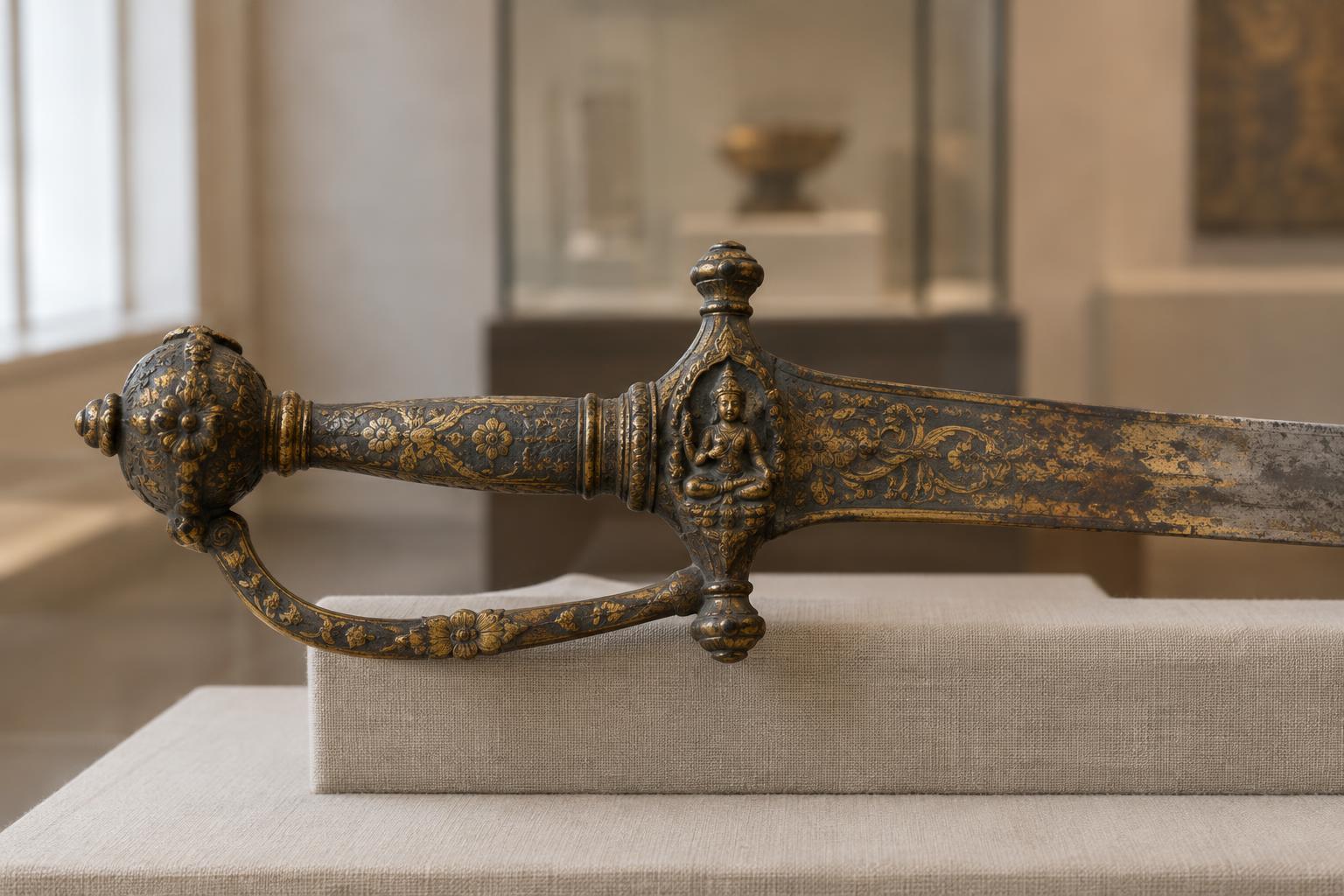
The place of an image matters. A small engraving near a sword hilt could have been especially meaningful to its owner, while a prominent figure on ceremonial armour could also have addressed an audience. Even then, an image alone cannot establish what an individual believed. Commissions, gifts, later alterations and changes of ownership all complicate the connection between an object and the person who used or displayed it.
Recognising figures and reading their attributes
Saint George is often shown confronting a dragon, a scene that made him readily recognisable and suited a wider language of courage and Christian victory. Saint Michael, an archangel rather than a human saint, may appear with wings, a sword or scales. Such attributes help identify a figure, but they also invite interpretation: an image might evoke protection, divine judgment or triumph over evil, depending on its setting.
Not every armed figure is a saint. Classical heroes, rulers, allegories and heraldic figures could occupy similar spaces on metalwork. Wear, repairs or incomplete decoration may obscure the features needed for a confident identification. A useful description begins with what remains visible, such as wings, a halo or an accompanying inscription, before naming the figure. This approach leaves room for uncertainty rather than treating a familiar-looking image as proof.
Patronage, belonging and public display
Saints could link an object to a place or a group as well as to an individual. A patron saint associated with a town, court, religious institution or military community might appear beside coats of arms, mottos and other signs of belonging. Saint Barbara, for example, became associated in parts of Europe with artillery communities. Her image on an object should still be read alongside its date, decoration and known history, rather than taken as a simple label for its owner.
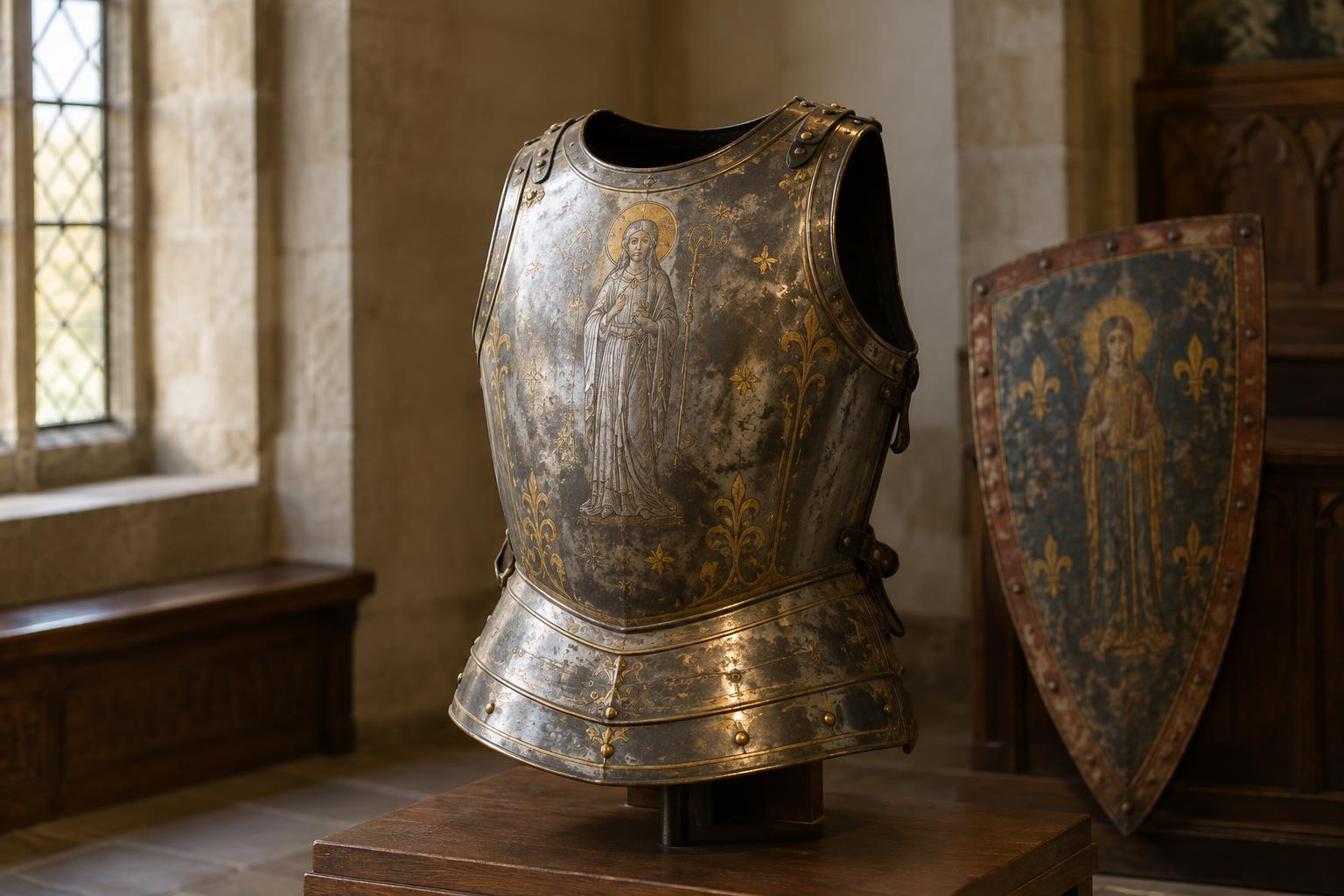
These connections could change over time. An object made for one setting might be presented as a gift, inherited or placed in a collection, where its saintly image acquired new significance. On richly decorated arms and armour, religious figures might also sit within a carefully planned programme of dynastic or political imagery. Devotion and public display were not necessarily opposites: a patron could choose imagery that expressed faith while also communicating status and allegiance.
What the whole object can tell us
Interpretation becomes stronger when the image is considered as part of the object. Its position, scale and technique can suggest whether it was central to the original design or added later. An engraved saint may be integrated with borders and neighbouring scenes; an applied badge may have a different history. Inscriptions can offer clues, though their meaning depends on accurate reading and on whether they belong to the same phase of decoration.
Context is equally important. Records of a commission, an early inventory entry or a securely documented findspot may support a particular interpretation. Without them, the safest account may be more modest: an object bears the image of a likely saint, but its first owner and intended message remain unknown. This is especially important for pieces that have been assembled, restored or separated from related equipment.
Presenting sacred imagery in collections
Museum displays can help visitors see these objects as more than examples of craftsmanship or conflict. A clear label might identify the figure, explain the attributes used for that identification and distinguish established facts from possible meanings. Showing related devotional art or civic symbols can make familiar images easier to understand without assuming that every viewer shared the same beliefs.
Conservation also shapes what can be learned. Cleaning or restoration may affect faint inscriptions, gilding and other evidence of how an image was made or changed. Careful documentation of present condition and earlier interventions helps preserve that evidence for future study. Saints on arms and armour reward this close attention: their images connect skilled metalwork with the beliefs, affiliations and ambitions of the people who commissioned, owned and encountered these objects.