Words as part of the object
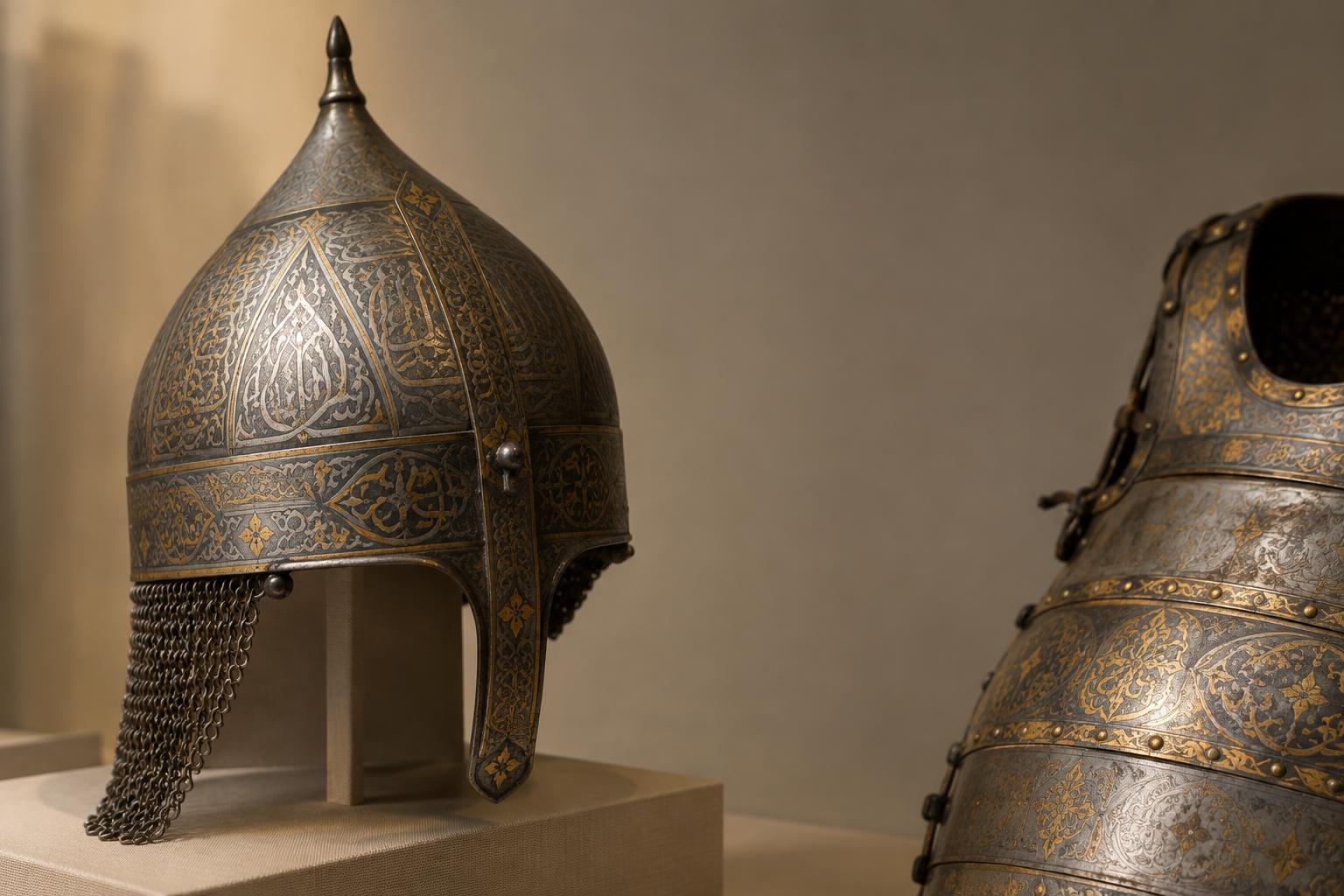
Calligraphy on arms and armour from Islamic societies is more than a label added to metal. It can be a central part of an object’s design, shaped to follow a blade, fit within a roundel, or frame a helmet or shield. The lettering may share space with floral patterns, geometric forms, and precious-metal decoration. Its appearance matters, but so does what it says.
“Islamic arms and armour” covers objects made across many regions and centuries, not a single style or tradition. Inscriptions may be in Arabic, Persian, Ottoman Turkish, or another language, and their meaning depends on the setting in which an object was made and used. A reader should therefore be wary of assigning one fixed purpose to every elegant line of script. The same visual feature might contribute to devotion, prestige, commemoration, or some combination of these.
Devotional text and expressions of hope
Some inscriptions contain religious phrases: a declaration of faith, a short prayer, a divine name, or a passage associated with protection and trust in God. Such words could express the beliefs and hopes of an owner or patron. They also placed the object within a wider visual culture in which meaningful writing appeared on buildings, ceramics, textiles, and other possessions.
A devotional inscription does not, by itself, tell us how an object was used or whether its owner considered the words a guarantee of safety. A phrase might have been chosen for its spiritual meaning, its familiarity, its beauty in a particular script, or several reasons at once. Placement offers clues, but it rarely settles the question: text prominently displayed to others and text positioned for a close viewer can both carry personal significance.
Praise, rank, and remembrance
Other inscriptions praise a named ruler, patron, or owner. They may give titles, offer good wishes, or present a person as generous and powerful. On a finely decorated object, such language can help communicate status alongside the quality of the materials and workmanship. It may also mark a gift or recall a particular relationship, although that interpretation needs support from the wording and the object’s history.
Names require careful reading. A name on a piece might identify its commissioner, recipient, owner, or a figure honored by the inscription; it does not automatically identify the person who made it. Titles, spellings, and formulaic phrases can help narrow the possibilities, yet similar names may belong to different people. A museum label that distinguishes what an inscription actually states from what scholars infer gives visitors a clearer understanding of the evidence.
Attribution and the maker’s mark
Inscriptions can sometimes connect an object with an artisan or workshop. Wording equivalent to “made by” offers a stronger clue to manufacture than a name standing alone. Even then, an object may have passed through several hands: one craftsperson could have formed the metal, another applied ornament, and another added an inscription. A named maker need not have completed every stage.
Reading an inscription is only one part of attribution. Its script and decorative technique can be considered alongside the object’s construction, materials, and documented provenance. Later additions are another possibility. An older piece might have been altered or embellished after it was first made, so the date suggested by its lettering need not be the date of every component. Careful attribution leaves room for these different histories rather than forcing an entire object into a single moment.
Looking closely without losing context
Museum displays can make inscriptions easier to appreciate through clear photographs, transcriptions, translations, and notes about uncertain readings. Curved surfaces, wear, repairs, and stylized letters may make even a short text difficult to decipher. A translation is most useful when visitors can see where the words appear and understand why a reading is confident or tentative.
For collectors and custodians, preserving that evidence matters. Abrasive cleaning or an undocumented repair can obscure letterforms and remove clues about how decoration was applied. Recording inscriptions as found, along with their position and condition, helps future readers revisit an interpretation. Approached this way, calligraphy is neither mere ornament nor a simple answer to an object’s identity. It is historical evidence that rewards patient reading in company with the object itself.