What heraldry can tell us
Heraldry is a system of identifying and describing emblems, especially those associated with people, families and institutions. It developed in medieval Europe and changed over time and from place to place. On historic armour, heraldic imagery can appear on a shield, a helmet fitting, a textile worn over armour or a decorated metal surface. It might identify an owner, honour a patron, express allegiance or contribute to a ceremonial display.
A recognizable emblem is a useful clue, not a complete identification. Armour could be altered, inherited, assembled from different pieces or decorated for an occasion. Museum displays may bring together objects that were not originally worn together. The first question is therefore not simply “Whose arms are these?” but “Where is the emblem, how was it made, and what else do we know about this object?”
Start with the shield
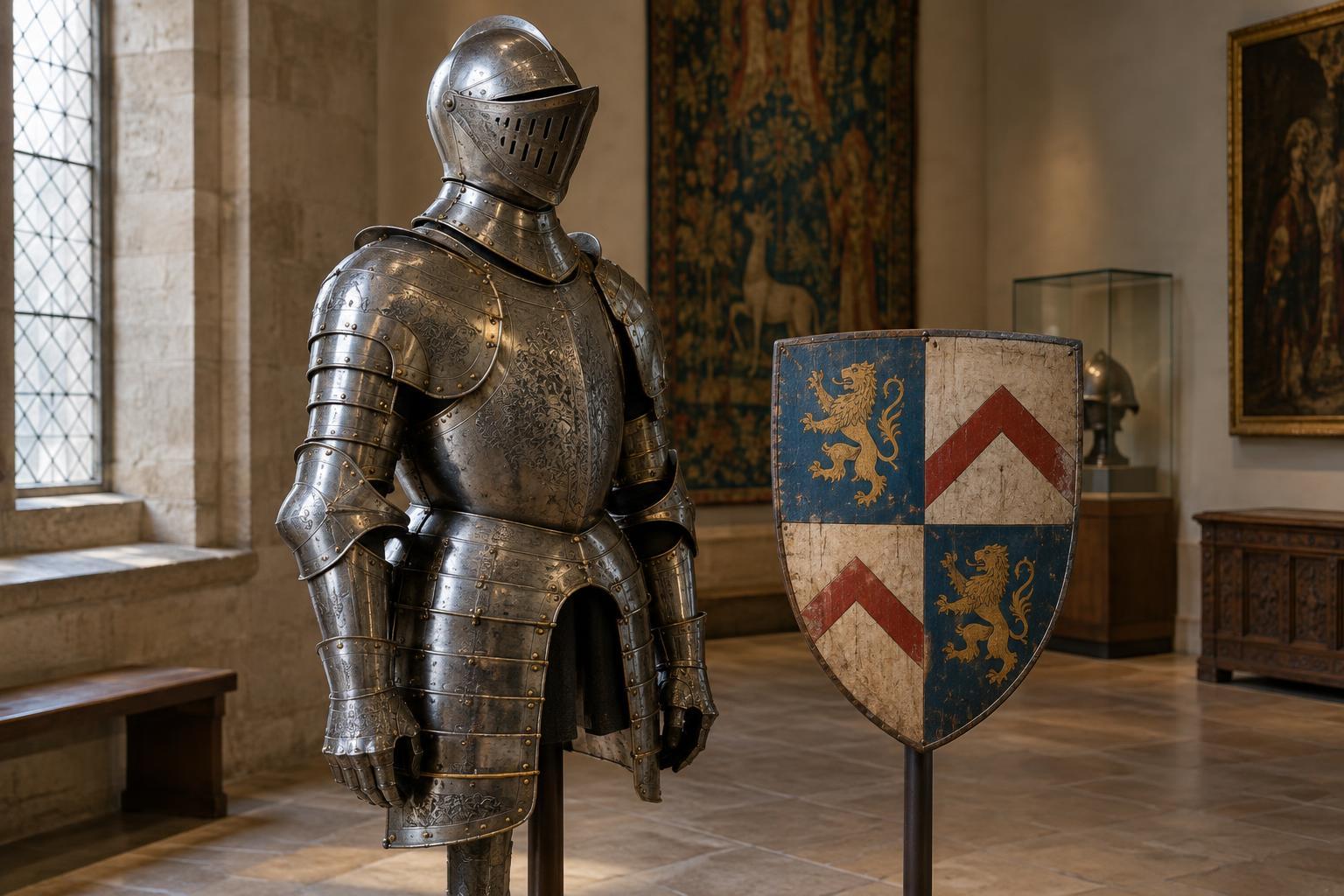
The shield-shaped field that carries a heraldic design is called an escutcheon. Its outline is less important for identification than the design within it: shield shapes varied with fashion, region and artistic purpose. A painted shield might have room for a full arrangement, while a small badge on a piece of armour might show only part of one. Begin by noting whether the field is plain, divided into areas or crossed by a broad geometric shape.
Heraldic descriptions use a consistent point of view. The right side of the shield, called dexter, is the bearer’s right and appears on the viewer’s left. Sinister is the bearer’s left and appears on the viewer’s right. This can feel backward when looking at an object in a case, but it matters when comparing designs that are otherwise similar.
Divisions of the field and geometric figures are often described with terms such as pale for a vertical band, fess for a horizontal band and bend for a diagonal band. You do not need to memorize a vocabulary before enjoying the object. A simple sketch recording the placement of the main elements is often a better first step than guessing a name from a single motif.
Recognize charges without overreading them
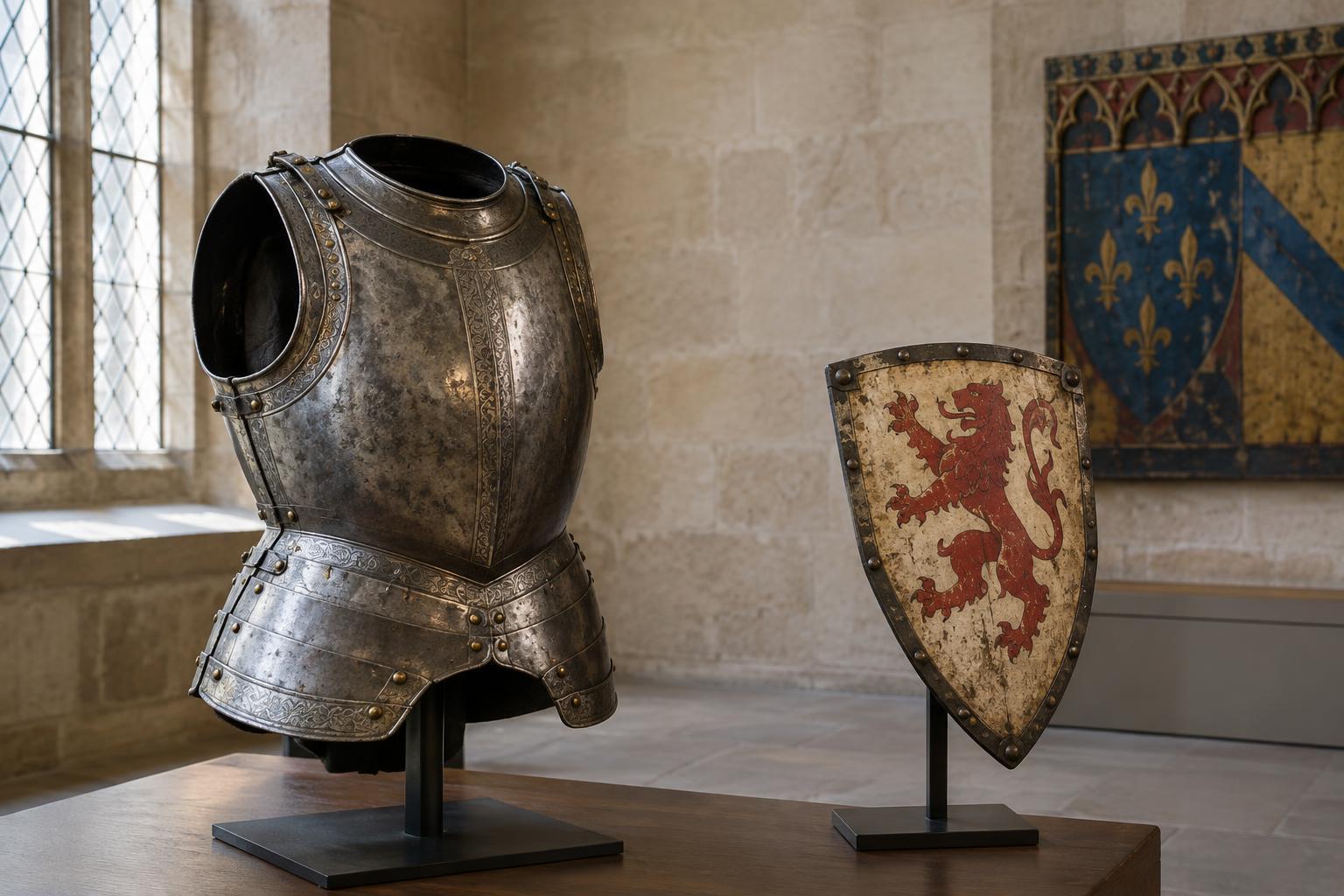
A charge is a figure placed on the field or on another heraldic element. Animals, plants, stars, crosses and human-made objects can all serve as charges. A lion, for example, may be shown standing upright, walking or in another conventional pose. Those differences, along with its colour and position, can be essential to the design. A lion alone is not enough to establish ownership.
Some motifs on armour resemble heraldic charges but serve a different purpose. A repeated flower or animal may be workshop decoration, a personal device or part of a broader visual theme. Conversely, an emblem need not reproduce an entire shield to carry an association. Look for repetition across related objects, inscriptions, documented provenance and the way a motif fits the rest of the decoration. These clues can strengthen an interpretation without making an uncertain identification certain.
Understand tinctures and their limits
Heraldic colours are called tinctures. Common terms include gules for red, azure for blue, sable for black and vert for green. The two traditional metals are or for gold and argent for silver; in images, they may also be represented by yellow and white. A written description of arms, called a blazon, names these features in a conventional order, usually beginning with the field before describing the figures placed upon it.
One familiar guideline is to avoid placing a colour directly on another colour, or a metal directly on another metal, because contrasting elements tend to be easier to distinguish. It is a helpful reading aid rather than a guarantee about every historical design. Wear, repainting, faded textiles and different artistic materials can also obscure a tincture. An engraved emblem on bare metal may preserve the shape of a design while giving little reliable evidence of its original colours.
Read the object as well as the emblem
Heraldry on armour belongs to a physical object with its own history. Consider whether the emblem was painted, etched, embossed, sewn or added as a separate fitting. Its location and workmanship may help explain whether it was intended to be seen at a distance or appreciated close up. A richly decorated piece might have been made for display or ceremony rather than presenting a straightforward record of everyday dress.
When viewing a museum object, compare the label with what you can observe. Does the label identify an owner, suggest an attribution or describe only a resemblance to known arms? Each wording signals a different degree of certainty. Recording the emblem’s layout, materials and visible condition makes for a more useful observation than relying on a quick match to a familiar symbol. Heraldry offers a way into the stories of identity and representation surrounding armour, provided the object itself remains part of the story.