An imperial signature in a ceremonial setting
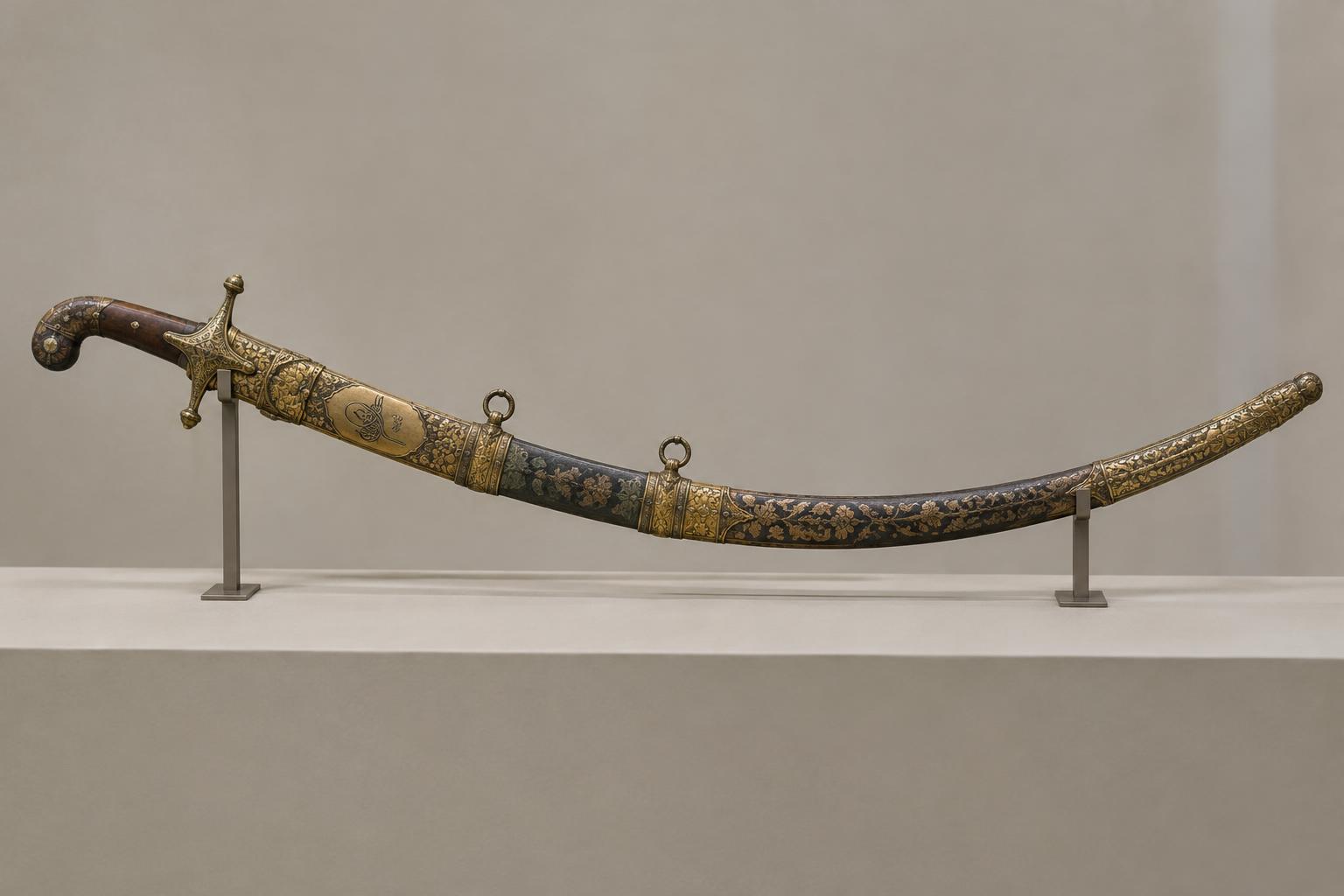
The tughra was a stylized calligraphic emblem associated with an Ottoman sultan. Its intertwined strokes could incorporate the ruler’s name, lineage and titles in a form recognizable as a sign of sovereign authority. Seen on a document, it occupied one kind of setting; placed on a sword, dagger, scabbard or other ceremonial furnishing, it entered another. There, its elaborate shape could contribute to an object’s public display as much as its written content.
Ceremonial arms were not simply tools. They could be presented, worn at court or displayed as signs of rank, allegiance and prestige. A tughra on such an object may invite a viewer to connect it with the ruler and the institutions of his reign. That connection is historically meaningful, but it is also broad: an emblem expressing imperial authority does not, by itself, tell us who commissioned the object or how it was used.
Reading the emblem as part of the whole object
Placement shapes interpretation. A tughra engraved prominently on a fitting may have been intended to be noticed in a formal setting. One worked into a dense decorative scheme may instead be best understood alongside inscriptions, floral motifs, precious materials and other marks of distinction. The material and method matter too: an emblem cut into metal, applied to a separate plaque or added to a replaced component belongs to a different physical story in each case.
The surrounding workmanship can help frame questions without settling them. Does the emblem appear consistent with the wear on nearby surfaces? Does its style sit comfortably with the other ornament? Is it on a component that could have moved between objects? Such observations do not authenticate a piece on their own. They help establish what needs closer study and discourage treating one striking detail as a substitute for examining the object as a whole.
What a tughra can and cannot attribute
When an inscription can be read with confidence, a tughra may identify the ruler it names. That identification can provide a valuable point of comparison for historians and curators. It does not necessarily establish when every part of the arm was made. Fittings can be repaired or replaced, and decoration can be added to an older object. Nor does the named ruler’s emblem prove that the sultan personally owned, handled or presented it.
Imperial imagery could serve several purposes: it might mark an official association, honor a patron, invoke dynastic authority or form part of a later attempt to give an object greater prestige. Those possibilities require different kinds of evidence. A documented presentation, an inventory description or a secure history of ownership may support a narrower attribution. Without such evidence, a careful description should separate what is visible—such as a tughra on a fitting—from what remains an interpretation.
Why provenance and condition change the reading
An object’s recorded history can clarify the significance of its decoration. Early collection records, photographs and descriptions may show whether a tughra was present before later restoration or changes of ownership. Even then, records need to be compared with the surviving object: a familiar name in a catalogue may have been carried forward without a fresh examination. Gaps in provenance are common and are better acknowledged than filled with a confident story.
Conservation observations offer another layer of evidence. Differences in surface wear, repairs or attachment methods can help identify which elements belong together and which deserve further investigation. Cleaning can also affect legibility, so a faint mark should not be forced into a reading that the surviving lines cannot support. Careful documentation preserves both the visible details and the uncertainty around them.
Interpreting sovereignty without overstating certainty
For a museum visitor, a tughra can be an entry point into Ottoman ideas of rulership and the ceremonial life of arms. An effective label might identify the emblem, explain its association with a named sultan if the reading is secure, and then describe the limits of that information. It can invite attention to craftsmanship and display while making clear that imperial symbolism is not the same as a verified imperial commission.
The strongest interpretation holds two ideas together. A tughra was a powerful sign, capable of giving a ceremonial object an unmistakably sovereign visual language. Yet the history of any particular arm depends on its materials, inscriptions, alterations and documentation. Reading those strands together respects both the emblem’s significance and the evidence the object can actually provide.