What a mon can—and cannot—tell us
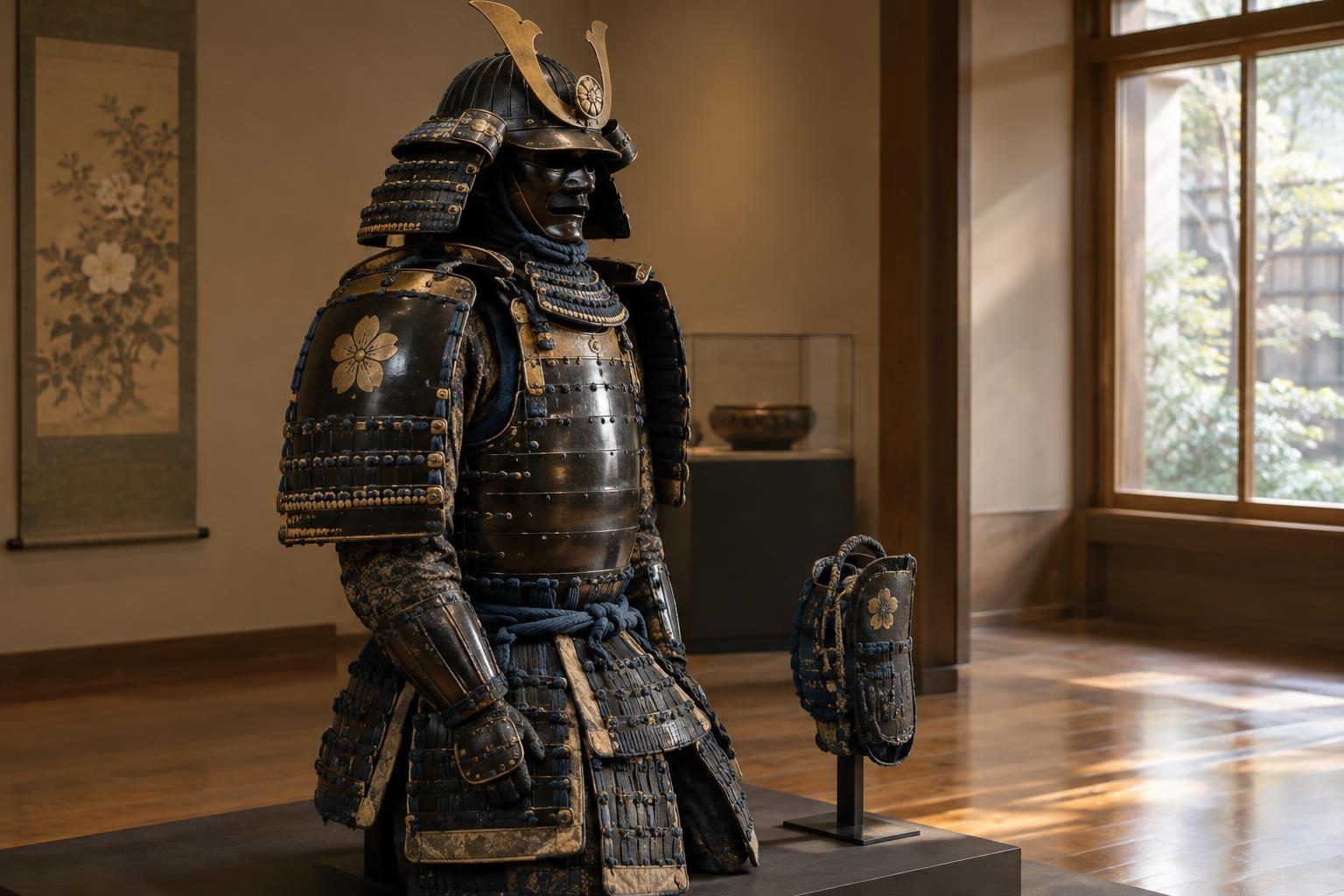
A mon is a Japanese emblem associated with a family, household or other group. Its designs often reduce a plant, object or geometric form to a clear pattern that remains recognizable at a distance. On armour, a mon may appear on a helmet fitting, a lacquered surface or a textile component. It can be a valuable clue to the social world in which an object was made, used, given or displayed.
The clue is not a signature. Similar designs could be used by different families, while related households might use variations of a shared motif. A crest can indicate affiliation without establishing which member of a household wore a particular suit. Nor does its presence necessarily mean that every component has always belonged together. Reading mon responsibly begins by separating the visible fact—this emblem is on this object—from a proposed identification of its owner.
Look at placement and materials
Before trying to name a crest, consider where and how it appears. Is it worked into an original-looking surface, attached as a separate fitting or carried on fabric that could have been replaced? Does the same design recur across several parts, and are those parts consistent in materials and finish? Such questions do not produce an answer by themselves, but they help establish whether the emblem belongs to a coherent decorative scheme or warrants closer investigation.
Armour is especially challenging because it is an assembly of many pieces. Components could be repaired, exchanged, altered for display or brought together long after their first use. A crest on a removable element may therefore tell a different story from a crest integrated into an older surface. Even repeated mon should be considered alongside construction and condition: matching emblems make an association more plausible, but they do not prove that every piece had one original wearer.
Allow for more than one kind of association
It is tempting to read a mon as a direct statement: this was the armour of one named person. Other interpretations may fit the evidence. An emblem might refer to a household under whose authority an object was made or maintained, a recipient of a gift, or a later custodian. A suit preserved for ceremonial or commemorative purposes could acquire meanings beyond those it held when its components were first made.
The distinction matters because ownership is only one part of an object’s history. Armour may pass between generations, and its presentation can change as families and collectors preserve it. A later addition is not automatically a flaw to be dismissed; it may document another period in the object’s life. The aim is to identify which relationship a crest may represent, rather than forcing every mark into a single-owner story.
Build an interpretation from several kinds of evidence
A careful identification compares the mon with the armour’s materials, workmanship and recorded history. Inscriptions, inventories, family records or documented transfers may offer useful context when their connection to the object can be established. Comparisons with other securely documented objects can also help, particularly when they address the form and placement of the emblem rather than the motif alone.
Each source has limits. A label written long after an armour was made may preserve an important tradition, but it may also simplify a complicated history. A visual match to a published crest may suggest possible affiliations without distinguishing among all its users. Good interpretation states the strength of the evidence: “bearing the crest associated with” is often more defensible than “worn by,” unless independent documentation supports the stronger claim.
Why careful labels make armour more interesting
Museum labels and collection records serve readers best when they make uncertainty visible. They can describe the mon, say where it appears, explain any known changes to the object and distinguish documented provenance from traditional attribution. This approach does not make the armour less meaningful. It invites visitors to see it as a crafted object with a history of use, care and interpretation.
For collectors and museum audiences alike, the most useful question is not simply “Whose crest is this?” but “What evidence connects this crest to this armour?” Looking closely at that connection brings craftsmanship, family identity and later stewardship into view. A mon can open a path into those histories without being asked to settle them all.