Armour as a composite craft
Japanese armour is not a single, unchanging design. Forms and methods varied across centuries, regions, makers, and intended uses. Even within one suit, a metal surface may sit beside lacquer, leather, silk, cotton, and other fibres. Its appearance is the result of many crafts working together rather than the work of a metalworker alone.
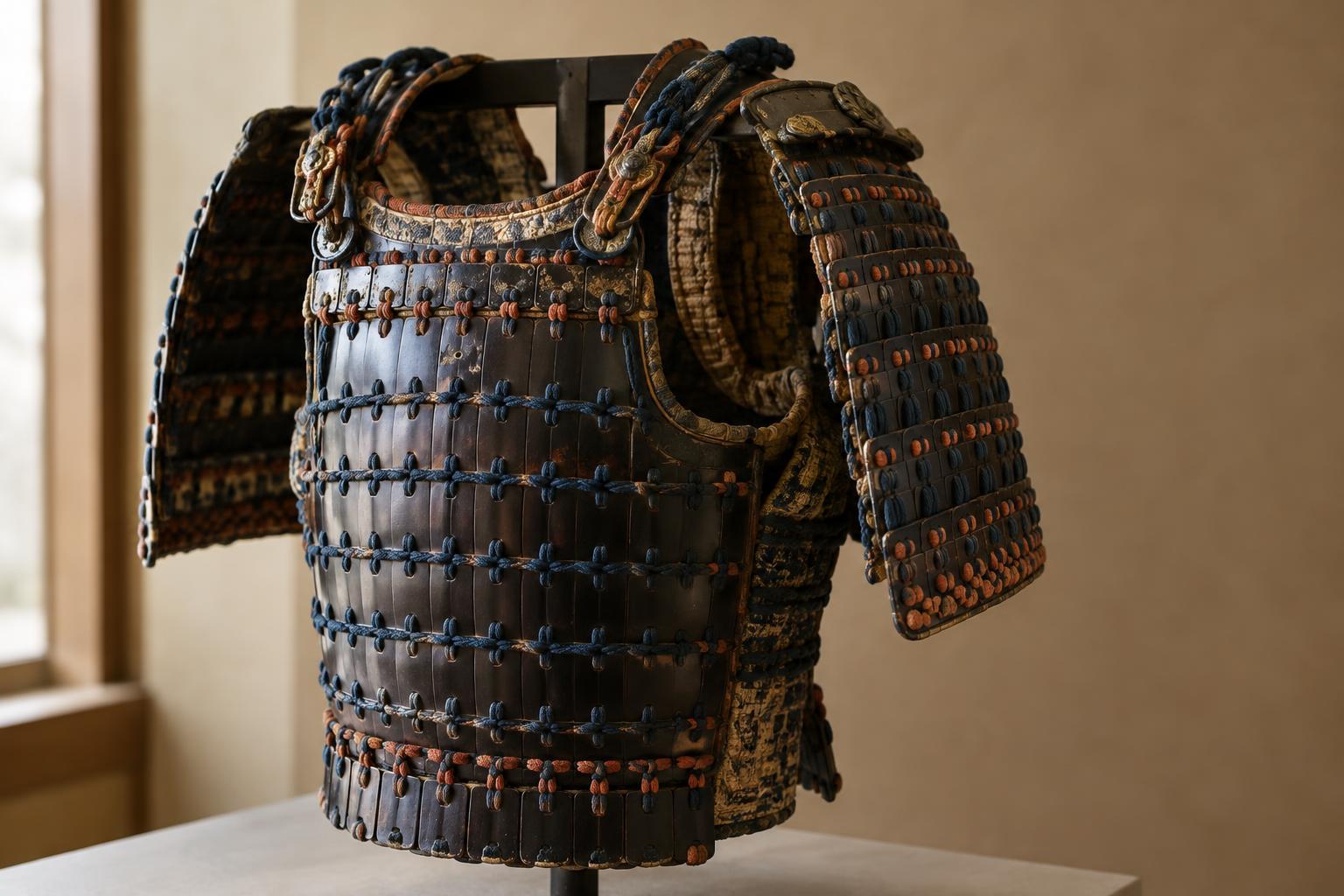
That mixture is especially clear in a cuirass, the body defence at the centre of a suit. Depending on its form, it may be built from rows of small elements, larger shaped plates, or a combination of components. Shoulder guards, skirt-like sections below the waist, and other attached pieces extend the same visual language around the body. Their materials and connections help explain both the armour’s shape and the impression it made when worn.
What the plates reveal
Many earlier styles used rows of small plates or scales, often called kozane, assembled into broader sections. A surface that appears to be one continuous band may therefore be made from numerous individual elements. Other styles rely more visibly on larger plates, which can give the body defence a smoother or more strongly articulated outline. These approaches should not be treated as a simple sequence in which one method entirely replaced another; makers could draw on different forms for different purposes.
Iron and leather both appear in historic Japanese armour, while lacquered finishes can obscure the material beneath. Lacquer helped create a unified surface and could contribute to protection against moisture, although an aged lacquer layer is itself vulnerable to damage. A dark, glossy plate should not automatically be identified as solid metal without closer examination.
The edges, joins, and curvature of plates are as informative as their decorated faces. They show how separate pieces were organized into sections and how those sections related to the wearer’s body. For a museum visitor, noticing repeated shapes and changes in scale is often more revealing than trying to identify every individual component at a glance.
Lacing as structure and display
Cords passing through rows of holes are among the most recognizable features of Japanese armour. Known broadly as odoshi, lacing could connect and visually organize rows of plates. Its spacing, colour, and pattern strongly affect the appearance of a suit: a closely laced section presents a different texture from one in which more of the underlying plates remain visible.
Lacing also complicates interpretation. A vivid arrangement may invite a symbolic reading, but colour alone rarely establishes a secure meaning. Choices could reflect fashion, patronage, workshop practice, or later repair. Cords are particularly liable to wear, fading, and replacement, so the pattern visible today may not reproduce every detail of an armour’s first assembly.
The paths taken by cords are worth observing even without touching the object. Where rows overlap, where lacing changes direction, and where a section meets a larger plate, the construction becomes easier to understand. These small details reveal the planning behind an apparently elaborate surface.
The textiles beneath and between
Cloth components can be easy to overlook beside lacquered plates and colourful cords. Yet armour also depended on fabric linings, bindings, and padded elements for its finished form. Textiles could cover edges, provide a surface against the body, or form part of flexible sections. Their textures and colours contributed to the overall design, including areas that would have been only partly visible when the armour was worn.
Surviving fabrics present particular challenges for interpretation. Exposure, handling, and earlier storage conditions can leave them faded or fragile. A neatly matched lining might be original, a historic alteration, or a later replacement; appearance alone may not settle the question. Collectors and museums therefore benefit from recording what is present without assuming that every component has the same age.
Reading and caring for a layered object
A suit of armour is best understood as an assembled object with a history of maintenance. Plates can be refinished, cords renewed, and textiles replaced while the broader form remains recognizable. Such changes do not make the object uninteresting. They may instead document how successive owners valued, preserved, or presented it.
For display and storage, the variety of materials calls for restraint. Unsupported weight can strain old connections, while unnecessary handling may damage brittle lacquer or weakened fibres. Stable conditions, appropriate support, and documentation of repairs help preserve evidence that cannot be recovered once lost. Seen this way, lacing, plates, and textiles are more than decorative details: together they record the armourer’s craft and the object’s continuing life.