What makes mail distinctive
Mail is a flexible material formed from interlinked metal rings. In historical armour it could be fashioned into garments, hoods, collars, and smaller protective pieces. Its familiar appearance can conceal considerable variation: the shape and size of the rings, the way they were closed, and the pattern in which they were linked all deserve attention.
A museum label may describe an object simply as “mail,” but even a small surviving area can contain evidence of workmanship. Looking closely also helps avoid a common mistake: treating every mail object as if it came from one place, period, or manufacturing tradition. Mail was used across many societies over a long span of history, and surviving examples need to be understood in their own contexts.
Riveted and solid rings
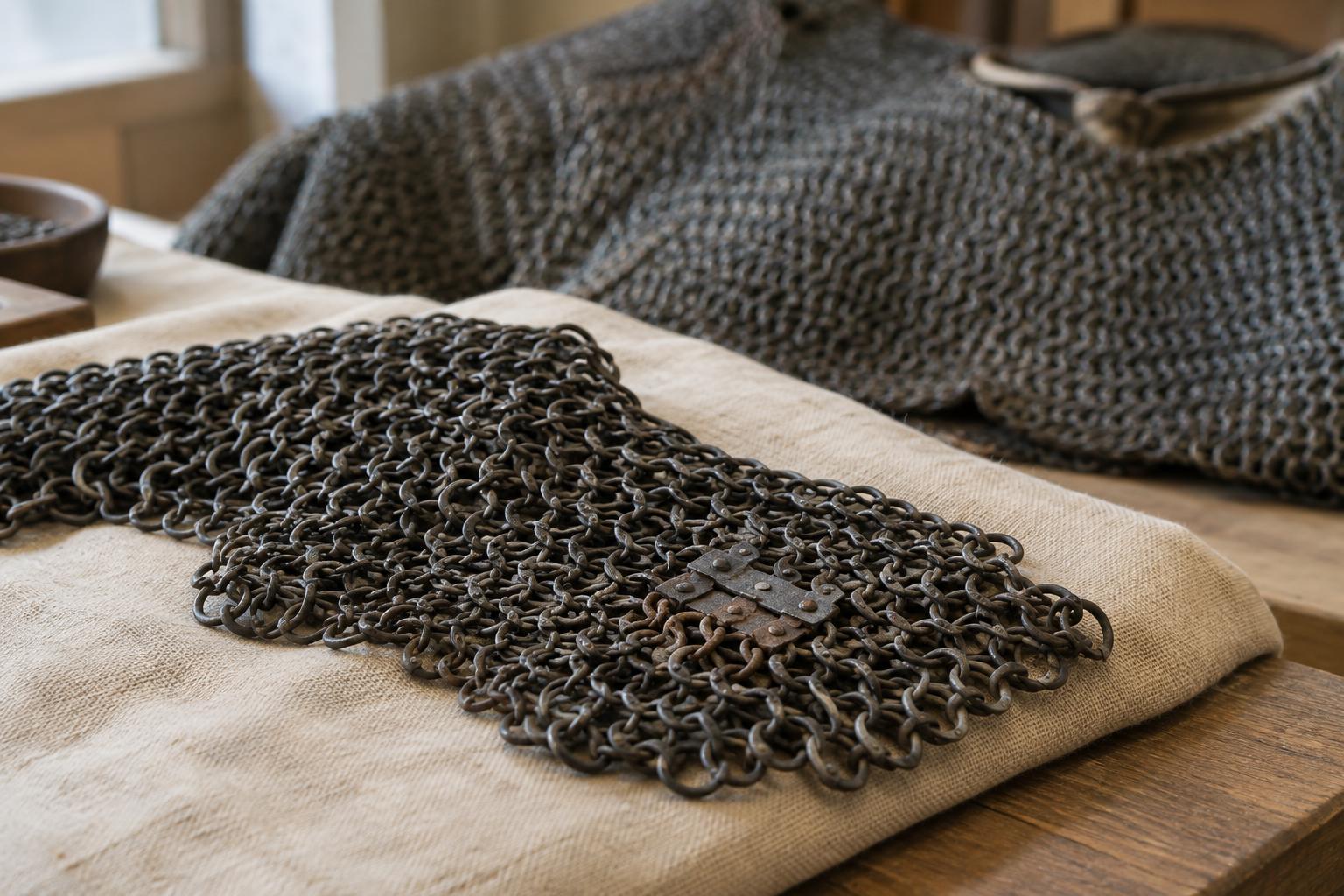
One important distinction is between rings closed with a rivet and rings made as continuous, solid loops. In a riveted ring, the ends overlap and are secured by a small fastener. That fastener may be difficult to see without close examination, especially when corrosion or old repairs obscure the surface. Solid rings have no comparable overlap; depending on the object, they may have been cut from sheet metal or formed by another method.
Some historical mail combines rows of riveted rings with rows of solid ones. That mixture is a feature to record, not a shortcut to identifying an object’s origin. Ring shape, fastening style, and arrangement can offer useful comparisons with other examples, but none is a reliable date or place label on its own. Rings may also have been replaced during an object’s working life or after it entered a collection.
Reading a weave
A weave describes the repeating way rings connect. In the pattern often called four-in-one, each ring links with four neighbouring rings in the main body of the fabric. It is widely associated with European mail, although that association should not be taken to mean that all European pieces are identical or that mail elsewhere followed a single alternative pattern.
Different traditions also joined rings in other arrangements. Some Japanese mail, for example, uses patterns that look unlike the dense, continuous fabric familiar from many European examples. Comparisons require care: a photograph can flatten an object’s structure, while a torn edge or folded section can make an ordinary pattern look unusual. Identifying a weave is easiest when a sufficiently large, undisturbed area survives and both faces of the material can be examined.
What variation can reveal
Changes in ring size or linking pattern may reflect the form of a garment, a reinforced edge, an attachment point, or a later alteration. A patch with noticeably different rings might be a repair, but appearance alone cannot establish when that work was done. Even within one object, wear and corrosion may have affected some areas more than others.
For a collector or museum visitor, the useful question is often not “Which weave is best?” but “Why does this area differ from the next?” A close view of the joins, transitions, and edges can help distinguish an intentional feature from a break or replacement. Those observations become more meaningful when considered alongside the object’s shape, documented history, and any associated materials, such as textile or leather.
The limits of surviving evidence
Mail rarely reaches us unchanged. Individual rings can be lost, joined incorrectly in a later repair, or hidden beneath corrosion. Pieces removed from their original garments may be difficult to orient, and an isolated fragment may reveal little about the size or purpose of the whole. Cleaning and display choices can also affect which details are visible to the public.
Careful interpretation therefore starts with description rather than certainty: note how the rings are connected, where rivets or solid rings appear, and whether the pattern continues across the surviving piece. From there, comparisons can suggest possibilities without turning every small feature into a firm attribution. Mail rewards this measured approach. Its rings preserve evidence not only of a protective object, but also of skilled labour, use, repair, and the changing history of the object itself.