What a royal cypher communicates
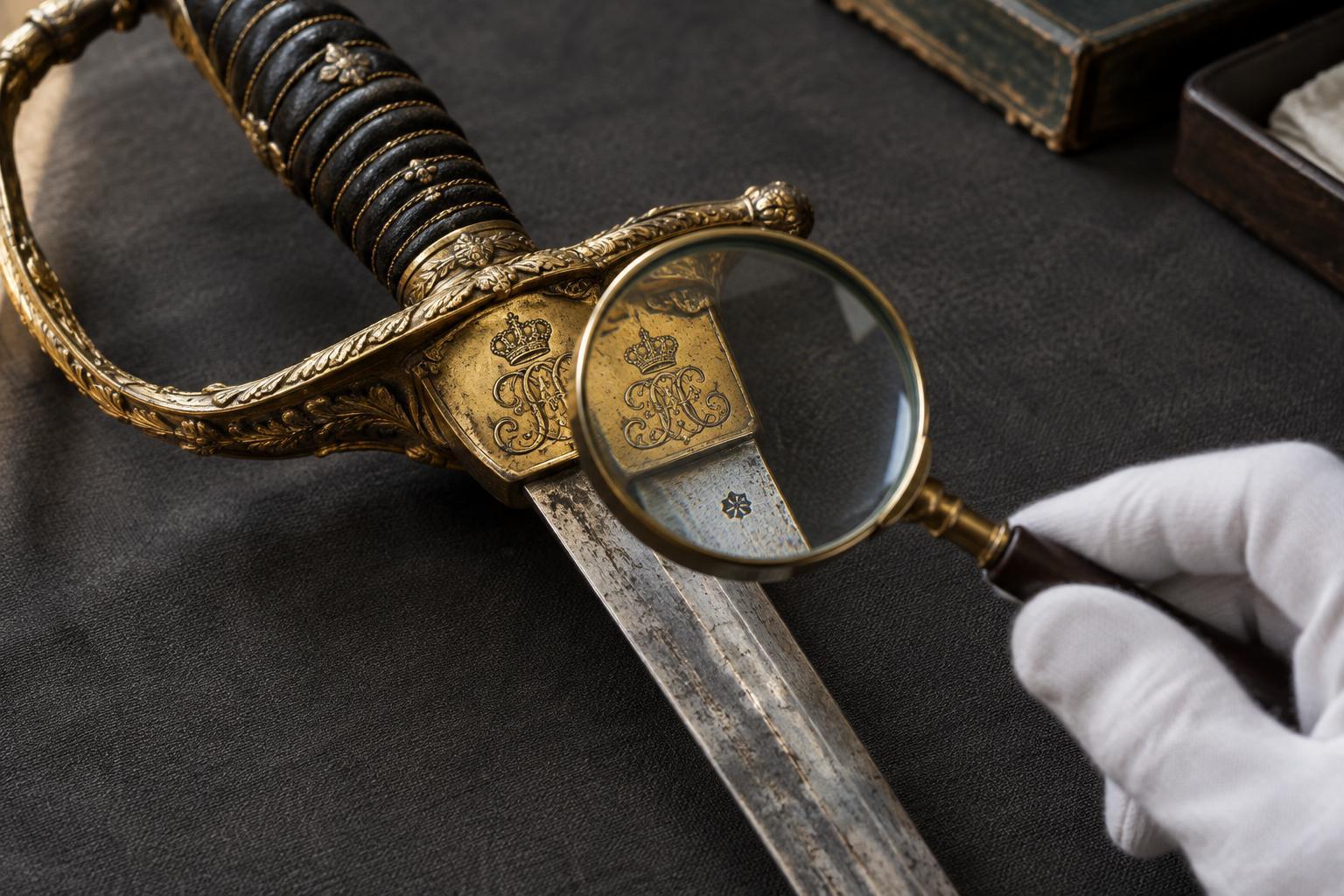
A royal cypher is a ruler’s identifying emblem, commonly formed from initials or a monogram and sometimes accompanied by a crown. On a historic weapon, it may express allegiance, official authority or an association with a royal household. It is not, by itself, proof that the ruler owned, handled or commissioned the object. The emblem’s meaning depends on the weapon’s setting and the reason it was decorated or marked.
Cyphers could appear on objects intended for display or ceremonial use as well as on equipment connected with institutions serving a monarch. Their visual prominence matters: an emblem worked into a decorative scheme may have been meant to be seen, while a small mark in a less conspicuous place may have served another purpose. Neither observation is conclusive without further evidence.
What a maker’s mark may tell you
A maker’s mark identifies, or purports to identify, a craftsperson, workshop or business associated with an object or one of its parts. It might take the form of a name, initials, a symbol or a stamped device. Its presence does not always mean that one maker produced the entire weapon. Different specialists could contribute components, and parts might later be replaced, repaired or brought together.
A maker’s mark and a royal cypher therefore answer different questions. The first may help investigate production; the second may help investigate authority, patronage or intended identity. The distinction can blur when both use initials or a small pictorial device. An apparently crowned set of letters should not be assigned to a monarch solely because it looks regal, just as unfamiliar initials should not automatically be treated as a maker’s signature.
Read the mark in its material context
Begin with what can be observed without altering the object. Record the mark’s exact location, size, orientation and relationship to nearby decoration. Note whether it appears engraved, stamped, inlaid, cast or applied separately. A cypher integrated into a larger ornamental design may invite a different interpretation from a compact stamp repeated on several components. Wear, corrosion and later finishes can make any of these features difficult to read.
Look at the whole object rather than an isolated close-up. Do marks on different parts seem consistent with one another? Does a crown form part of the same design as the letters beneath it, or could it be a separate addition? Are there signs that a marked component differs in finish or style from its surroundings? Such questions help frame an interpretation, but a difference is not automatically evidence of deception: historic objects often have complex histories of maintenance, adaptation and display.
Avoid turning a cypher into a date or provenance
Even a confidently identified royal cypher is not a complete dating tool. A ruler’s emblem might remain in use across a span of years, and an object bearing it could have been decorated after its main components were made. Conversely, an older component could have been incorporated into a later piece. The emblem can provide a useful clue, but it should be weighed alongside construction, decorative style, other marks and documented history.
Claims about ownership require particular care. A royal emblem may indicate an institution, a contract, a presentation context or simply a visual language of loyalty. It does not establish a direct journey from a ruler’s possession to a museum case or private collection. When comparing an object with catalogue descriptions or documented examples, pay attention to differences as well as similarities; a matching pair of initials is only a starting point.
Document uncertainty and preserve the evidence
For a collection record, a measured description is often more valuable than a confident but unsupported attribution. Transcribe visible letters as carefully as possible, describe any crown or surrounding motif, and photograph the mark both close up and in relation to the complete object. Keep earlier labels and records, even when their identifications are doubtful: they can show how an interpretation developed over time.
Do not polish, deepen or otherwise “clarify” a faint mark to make it easier to identify. The surface around it may retain evidence of how and when it was made, and intervention can remove that evidence. A useful label can state what is visible, explain why a royal cypher or maker’s mark has been proposed, and leave the question open where the evidence does not settle it. That restraint gives the object’s history more room to speak.