A similar surface, a different structure
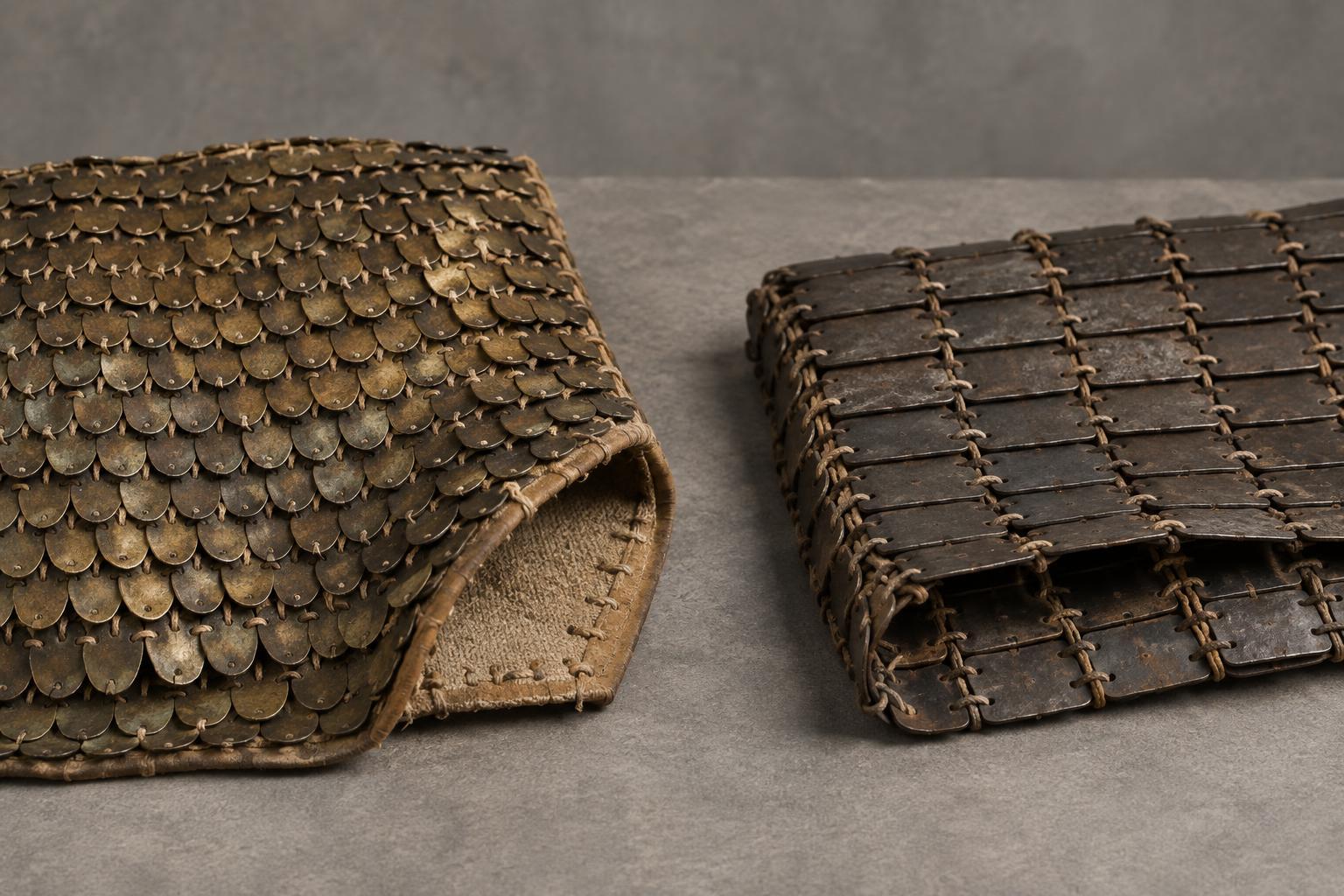
Scale and lamellar armour are easy to confuse in a photograph. Both may present rows of small, overlapping plates rather than a single continuous surface. Both could be made with considerable care, and both appear in varied historical traditions. Their most useful distinction is structural: scale armour normally relies on a separate backing to hold its plates, while lamellar armour is generally assembled by connecting its plates to one another.
That distinction matters more than the outline of an individual plate. A rounded lower edge does not automatically make a piece a scale, and a rectangular plate does not automatically make it lamellar. The location of attachment holes, the path of surviving cords or stitches, and the presence of a textile or leather foundation can tell a more informative story. Even then, an incomplete object may resist a confident label.
Scale: plates attached to a foundation
In a typical scale construction, numerous small plates are fastened to a backing, often imagined as a flexible garment of textile or leather. The plates overlap so that the visible surface resembles shingles or the scales of an animal. Their precise shape, size and arrangement vary. What makes the construction recognizable is that the backing provides the main support: remove it, and the plates no longer form the same coherent garment.
The foundation may be difficult to see on a finished piece, particularly where successive rows conceal the attachments. On an archaeological or fragmentary object, the problem can be reversed: organic backing may have deteriorated, leaving loose plates and little direct evidence of how they were worn. A museum description may therefore identify plates as belonging to probable scale armour while acknowledging that the original garment is no longer intact.
Lamellar: plates connected to plates
Lamellar armour is built from small plates, often called lamellae, joined into rows and larger sections through holes in the plates themselves. Cords or other flexible connections link neighbouring elements, creating a surface that can hold together without a full backing garment carrying every plate. Overlap remains important to its appearance, but the network of connections is the defining feature.
This construction makes the pattern of holes and connections especially revealing. A surviving lamellar section may show several attachment points on each plate, reflecting how its maker joined rows and managed their overlap. There is no single universal pattern: historical examples differ in plate form, materials and arrangement. Describing lamellar as simply “armour made of little plates” misses the craftsmanship in the connections that turn separate pieces into a wearable whole.
Why neat labels sometimes fail
Real objects do not always follow textbook categories. Armourers could combine methods, add linings or supporting materials, and repair a garment in ways that complicate its original structure. Words used for armour have also varied across languages, periods and museum catalogues. A historical name may refer to an appearance or a tradition rather than match a modern construction category exactly.
For that reason, classification begins with evidence rather than resemblance. If a plate is detached from its garment, its holes may suggest possible connections but not prove the complete arrangement. If an object has been restored for display, modern replacements can make a once-fragmentary surface look more certain than the surviving material warrants. Careful interpretation separates what is visible today from what has been reconstructed.
Looking closely in a museum
When viewing either type, look for the edges as well as the front. An opening, damaged area or exposed reverse may reveal a backing behind scales or connections running directly between lamellae. Labels and object photographs can help clarify which portions are original and which have been stabilized or recreated. From a comfortable viewing distance, it is also worth noticing how the rows contribute to the object’s visual rhythm and overall silhouette.
Construction is part of the armour’s cultural meaning, not merely a technical footnote. Choices about materials, visible finish and arrangement could reflect available skills, local conventions and the appearance a patron wanted to present. At the same time, surviving pieces offer only a partial record: textiles, leather and cords often preserve differently from metal. The most reliable comparison is therefore modest but powerful: ask what holds the plates together, then consider what the object can—and cannot—show about its original form.