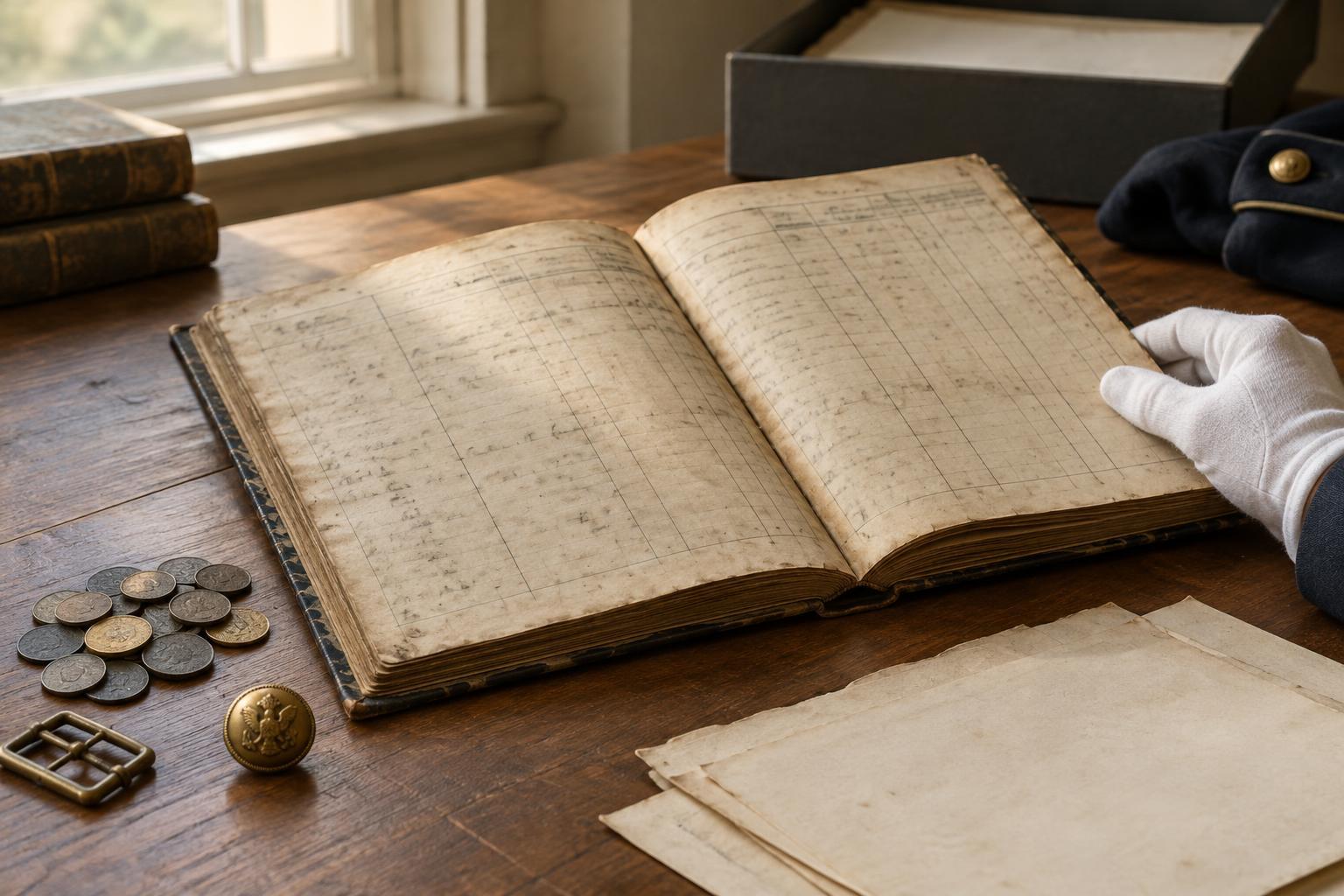
An army seen through its accounts
A pay record can look like one of the least dramatic objects in military history: names, amounts, dates and columns of deductions. Yet those columns describe a basic relationship between people and institutions. Who was entitled to payment? For how long? Who approved it, and who recorded it? The answers can help explain how a military force was organised and how its members were expected to support themselves.
The term “pay record” covers many kinds of document, from a muster roll noting those present to an account of wages owed or a receipt acknowledging payment. Their formats varied across places and periods. Before drawing conclusions, identify what the document was made to do. A list compiled to settle an account may tell us when a person was charged to a unit, but not necessarily when that person joined it, received money in hand or left service.
Rank, obligation and the meaning of a wage
Differences in recorded pay can reveal a hierarchy of roles. Officers, skilled specialists, ordinary soldiers and temporary workers might appear at different rates, although a higher figure did not always mean greater disposable income. Some people were expected to provide equipment, maintain a horse or meet other costs from their allowance. In other settings, food, clothing or lodging formed part of compensation. Comparing amounts is most useful when the terms of service are considered alongside the figures.
Entries for partial periods, arrears or deductions can be just as revealing as standard rates. They may point to interrupted service, administrative delay or rules governing absence. But an unexplained reduction should not be turned into a confident story of punishment or hardship. It may reflect a convention of bookkeeping that becomes clear only in related orders or accounts.
Pay records also show how authorities defined service. A clerk had to decide whose name belonged on a roll and which days counted. Such decisions made military labour legible to an administration, while leaving some contributions difficult to see. The work of supplying, transporting, washing, repairing and caring for others could sustain a force without appearing in the same records as enlisted service.
People and households beyond the columns
A named payment can offer a starting point for reconstructing a life, especially when several records can be compared. Repeated entries may suggest continuing service; a change in recorded role may suggest advancement or reassignment. Names alone, however, are rarely secure identifiers. Spellings can shift, people can share a name, and a person missing from one surviving document may appear in another. Dates, locations and unit descriptions help test a possible match rather than prove it automatically.
Wages also belonged to a wider household economy. Even when a record names only the person serving, payment could matter to dependants and to the communities that provided food, materials and labour. A receipt signed by a representative, for example, may show that money passed through another set of hands; it does not by itself explain the relationship or the recipient’s circumstances. Questions about family life often require other types of evidence, such as correspondence, local accounts or petitions.
What survives can shape our impression of who mattered. An institution might preserve careful records for those on its formal payroll while leaving irregular workers, unpaid helpers and civilians at the margins. This is not a reason to disregard the accounts. It is a reason to read their silences as evidence of the recordkeeping system, not as proof that unlisted people were absent.
Reading an account without overreading it
Start with the document itself. Note its title, date range, units of currency or payment, column headings and any marks showing corrections or approval. Ask whether figures are rates, totals, debts or sums actually disbursed. If the account is a copy, consider whether entries may have been regularised after the events they describe. A neat total can conceal months of uncertain or delayed payment.
Next, place the record beside other evidence where possible: muster lists, supply accounts, regulations, letters or surviving equipment. Such comparisons can turn an isolated amount into a more useful question about expected costs and lived conditions. They can also expose contradictions. Rather than forcing those sources to agree, explain what each was designed to record.
For a museum visitor, collector or reader, a pay document offers a valuable counterpart to uniforms, weapons and portraits. Objects can show materials and workmanship; accounts can show the systems that assigned value to service and helped sustain it. Neither provides a complete picture on its own. Together, they invite a view of military history that includes administration, labour and social relationships as well as the visible artefacts of war.