A label is a summary, not a final verdict
The label beside a helmet, sword or breastplate has a difficult job. In a few lines, it may identify an object, suggest where and when it was made, explain its use and place it in a wider story. Those statements are usually drawn from a much larger body of information: collection records, earlier publications, physical examination and comparisons with other objects. Because space is limited, the label cannot show every piece of evidence or every uncertainty behind its wording.
A change to a label does not necessarily mean that an earlier curator was careless. Earlier descriptions may have reflected the best available knowledge, or a convention that later researchers have questioned. Museums also make different choices about what visitors most need to know. One label might emphasize an armourer’s skill; a later version might give more space to the wearer, the object’s symbolic meaning or the history of its collection.
New evidence can change an attribution
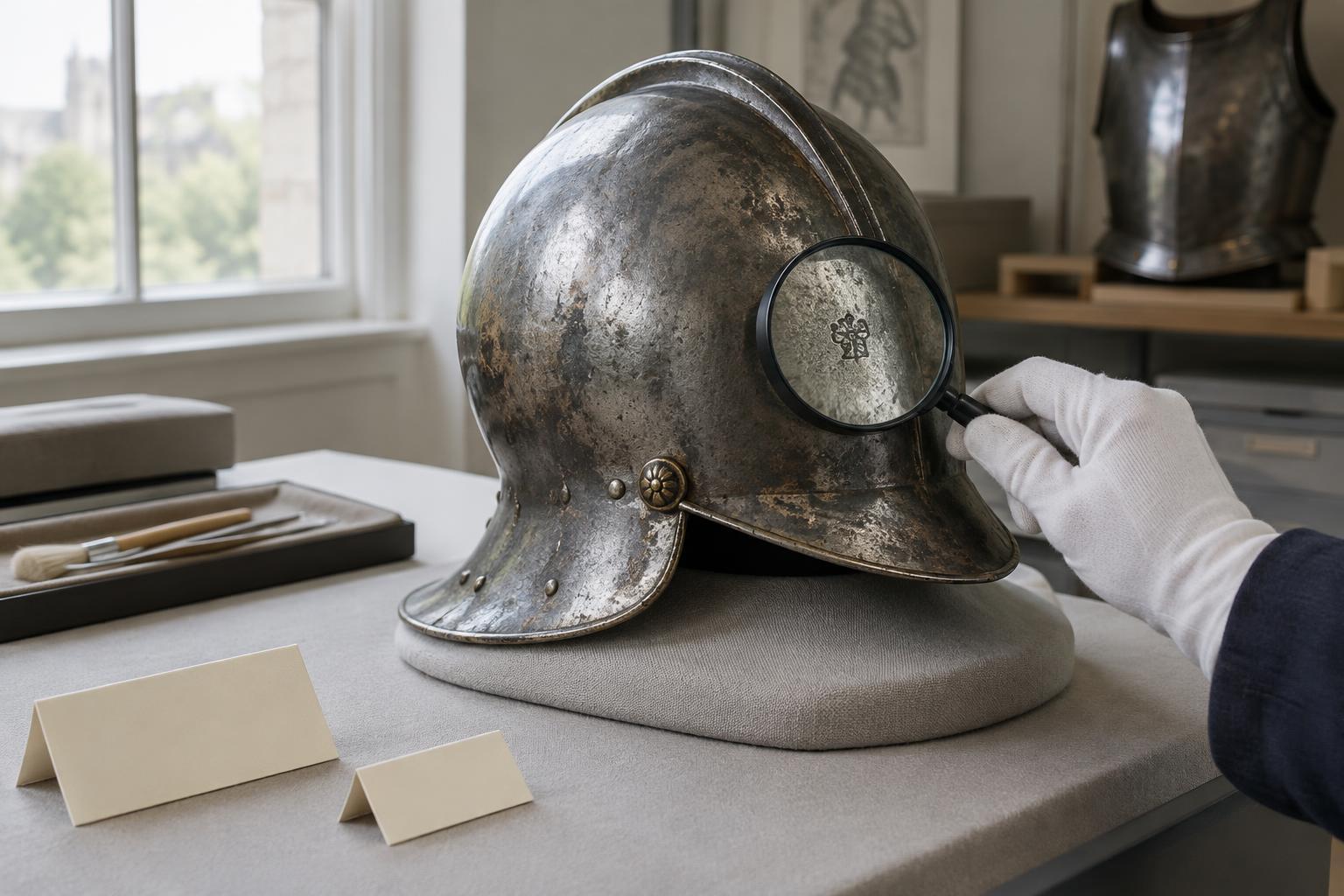
An attribution is a reasoned identification of an object’s maker, place or period. It may rest on a maker’s mark, a distinctive form, a decorative technique or a documented connection to a person or workshop. Yet marks can be hard to read, styles can travel between regions, and components may have been altered or assembled at different times. A label that once named a particular workshop may later use a broader description if closer study shows that the evidence does not support such precision.
Research can also sharpen a description. An inventory entry, a historic image or a comparison with a better-documented object may help distinguish between two plausible interpretations. Close examination during conservation may reveal details previously obscured by dirt, repairs or display fittings. Such findings need careful interpretation: an unusual feature is a clue, not proof by itself. This is why labels may use phrases such as “attributed to,” “probably” or “possibly.” Those words tell visitors how confidently the museum can make a claim.
An object has more than one history
A museum object’s story did not end when it was made. Armour could be adapted, passed between owners, stored, restored or displayed in ways that changed its appearance and meaning. A label focused only on an original date and place may miss these later chapters. As collection records are reviewed, a museum may decide to distinguish more clearly between the date of manufacture, the date of a later alteration and the date when an object entered the collection.
Questions about ownership can also reshape interpretation. An old label might record that a piece belonged to a famous figure, while a newer one might explain that the connection comes from a later tradition rather than contemporary evidence. Revising that wording does not erase the tradition; it helps readers tell the difference between a documented history and a story attached to the object afterward. Where an object’s route into a collection remains incomplete, a label can acknowledge that gap rather than imply an unbroken record.
Interpretation changes alongside knowledge
Labels reflect decisions about language and emphasis as well as factual identification. Terms once used as broad categories may prove too vague for objects made across different places and periods. A museum may replace them with more specific wording, or explain why a familiar name is still used. It may also bring forward perspectives that an older display overlooked, including the work of craftspeople or the ceremonial and social roles of arms and armour. The physical object has not changed, but the questions asked of it have.
When you encounter a revised label, look for the distinction between what can be observed and what has been inferred. Materials, construction and visible marks are different kinds of evidence from an attributed maker or a proposed owner. Notice qualifying words, and consider whether the label describes the object’s making, later use or museum history. A good label does not need to resolve every question. Its value lies in offering a clear account while leaving room for responsible revision when the evidence or the interpretation develops.