What fluting changes
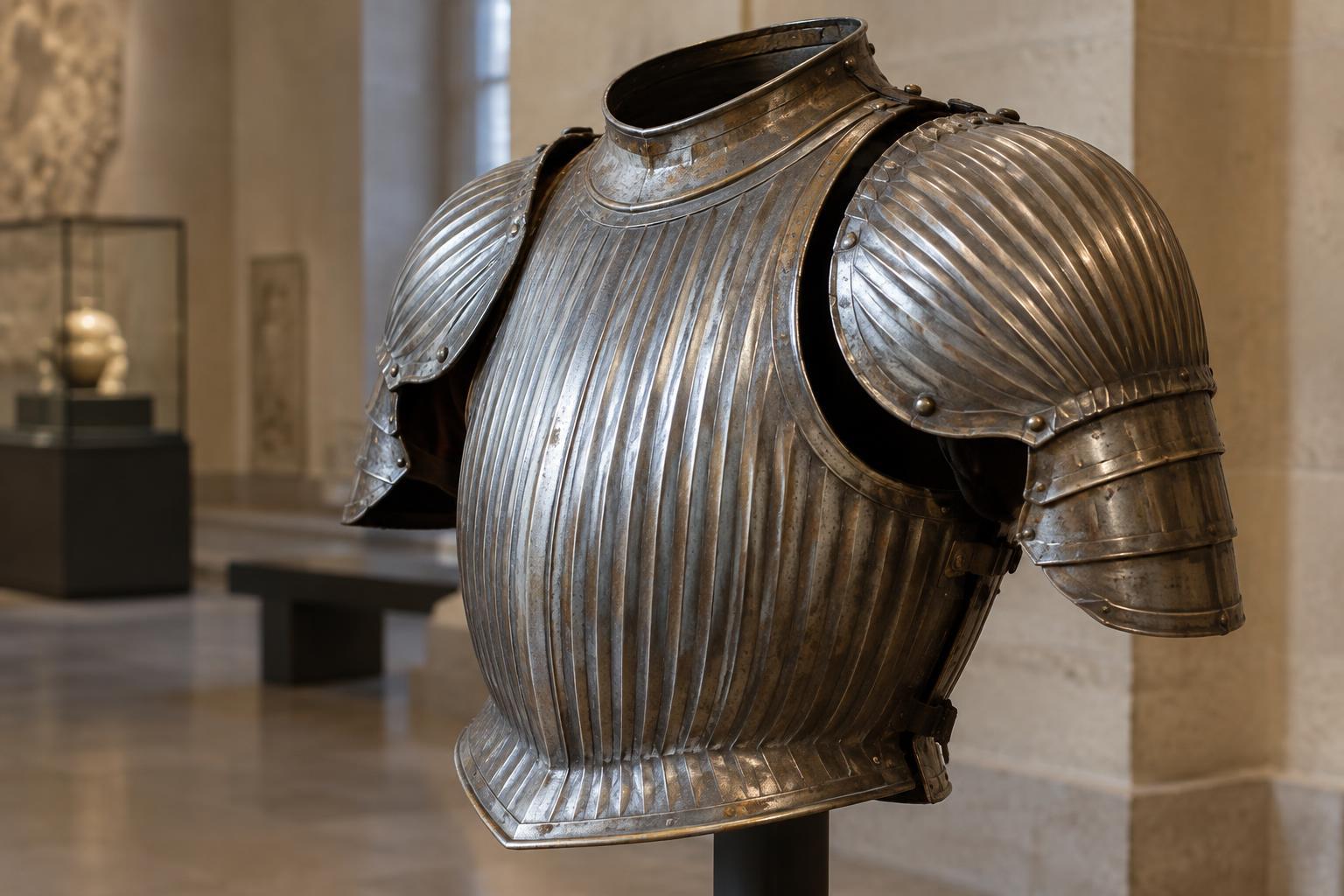
Fluting consists of raised ridges and recessed channels worked into a metal plate. On armour, these lines might run down a breastplate, radiate across a shoulder defence, or repeat along an arm or leg. They give a surface rhythm that is visible even from a distance. Under changing light, a fluted plate can appear to have sharper contours than a smooth one of similar overall shape.
The ridges also change the geometry of the metal. A shaped plate is not simply a flat sheet with a pattern drawn on it: its surface has been worked into alternating slopes and crests. This can add stiffness in particular directions, although the effect depends on the plate’s thickness, shape, and construction. It is therefore too simple to call fluting either purely decorative or a universal engineering improvement. An armourer could value both its physical and visual effects.
A demanding part of the armourer’s work
Regular fluting required planning. Lines had to relate to the plate’s curves, openings, and points of overlap with neighbouring pieces. A ridge that looks straight from the front may follow a carefully adjusted path over a rounded surface. Where several plates sit together, the pattern may continue visually across them, even though each piece was shaped separately.
The finish mattered as much as the initial shaping. Uneven spacing or an abrupt ending could disrupt an otherwise orderly design. An armourer might use changes in the width, depth, or direction of flutes to lead the eye toward a central line or to make a broad surface seem more slender. Looking closely at these transitions can be more revealing than counting the ridges. It shows how the maker reconciled a repeated pattern with the particular shape of each component.
Fluting should not be confused with every line visible on an armour plate. Engraved lines cut into a surface, while applied strips add material to it; both can create patterns without the same change in the plate’s underlying form. Some objects combine several techniques. Raking light and views from more than one angle can help a museum visitor distinguish a raised ridge from a line made chiefly by surface decoration.
Style is evidence, not a shortcut
Fluted armour is often associated with particular European fashions, but the presence of flutes alone does not securely identify a date, workshop, or wearer. Styles could be adapted, revived, or imitated. Separate components might also have been brought together later. To understand an object, its fluting needs to be considered alongside its overall form, construction, decoration, condition, and documented history, where that history exists.
Even within one suit, the pattern need not be uniform. A maker might leave an area smooth for contrast, adjust the design around a joint, or give a prominent piece a more elaborate treatment. Those choices may reflect appearance, practical constraints, or a patron’s preferences. Unless supporting evidence survives, it is best to describe the visible decision rather than assign a definite motive to it.
Photographs can make comparisons difficult. Strong directional lighting exaggerates relief, while flat lighting can nearly erase shallow flutes. A polished reproduction and a worn historic plate may also look strikingly different for reasons unrelated to their original designs. When comparing objects in catalogues or displays, notice the lighting, viewing angle, and state of the surface before drawing conclusions from the apparent boldness of a pattern.
Reading fluting in a collection
Start with the whole object. Where does the pattern begin and end? Does it follow the body’s contours or draw attention to a particular component? Then move closer: are the ridges evenly spaced, or do they narrow and spread to accommodate the plate’s shape? If adjoining pieces survive, look for deliberate visual relationships rather than assuming that every repeated line must connect perfectly.
Finally, consider what the object cannot readily tell you. Polishing, corrosion, repair, and later assembly can alter the way fluting appears today. A missing plate may once have completed a design, while a replacement may introduce a different one. These possibilities do not make close looking futile. They make it more useful: fluting offers a way to appreciate the armourer’s control of form while keeping observation separate from speculation.