A victory claim is a story as well as a statement
A chronicle may announce a victory in a few confident lines: an enemy was defeated, a ruler prevailed, and order was restored. Such passages are valuable, but they do more than record an outcome. They can praise a patron, explain a change in power or give a community a memorable account of its past. A careful reader therefore asks two questions at once: what might have happened, and why was it described in this way?
Even the word “victory” can cover different results. One side might hold the field while the other preserves much of its force. A campaign might achieve a political aim despite a setback in battle. A chronicler writing after the event may also know how the wider conflict ended and describe an earlier encounter in that light. Before accepting a claim, it helps to identify exactly what success the text says was achieved.
Consider the writer, audience and purpose
Chronicles were written from particular positions. A writer might have relied on participants, earlier accounts or reports circulating well beyond the place of the fighting. The intended readers mattered too. An account prepared for a court, religious institution or local community could emphasize different people and different meanings. This does not make the text worthless; its point of view is part of the evidence it offers.
Look for signs of what the author wants readers to remember. Who receives credit? Are leaders described as courageous or divinely favored, while opponents are portrayed as disordered or dishonorable? Does the account connect the outcome to a claim of rightful rule? These choices can show how a victory was made meaningful. They do not, by themselves, tell us whether every reported action occurred as written.
Read the language closely
The scale of a claimed triumph often rests on words that sound precise but are not. Phrases such as “the whole army,” “countless dead” or “complete destruction” may express the force of an event rather than provide a measured tally. Conversely, a brief notice of a defeat may leave out its scale. Descriptions of losses, captures and retreats deserve particular care when the account gives no basis for its figures or uses rounded, dramatic language.
Sequence matters as much as vocabulary. A chronicler may join several encounters into one smooth narrative, omit a pause in a campaign or place a later consequence immediately after a battle. Comparing passages within the same text can expose uncertainty: a claim of total defeat may sit uneasily beside a later description of the supposedly defeated side acting again. Such tensions invite a narrower reading, not an automatic rejection of the entire account.
Compare accounts without expecting a perfect match
If other accounts survive, differences between them can be instructive. Writers may disagree about who initiated an encounter, who withdrew or what counted as the decisive moment. Neither agreement nor disagreement settles the matter on its own. Accounts can share a source, repeat a familiar story or describe different parts of a complicated event. Comparing them is most useful when each text is read in its own setting first.
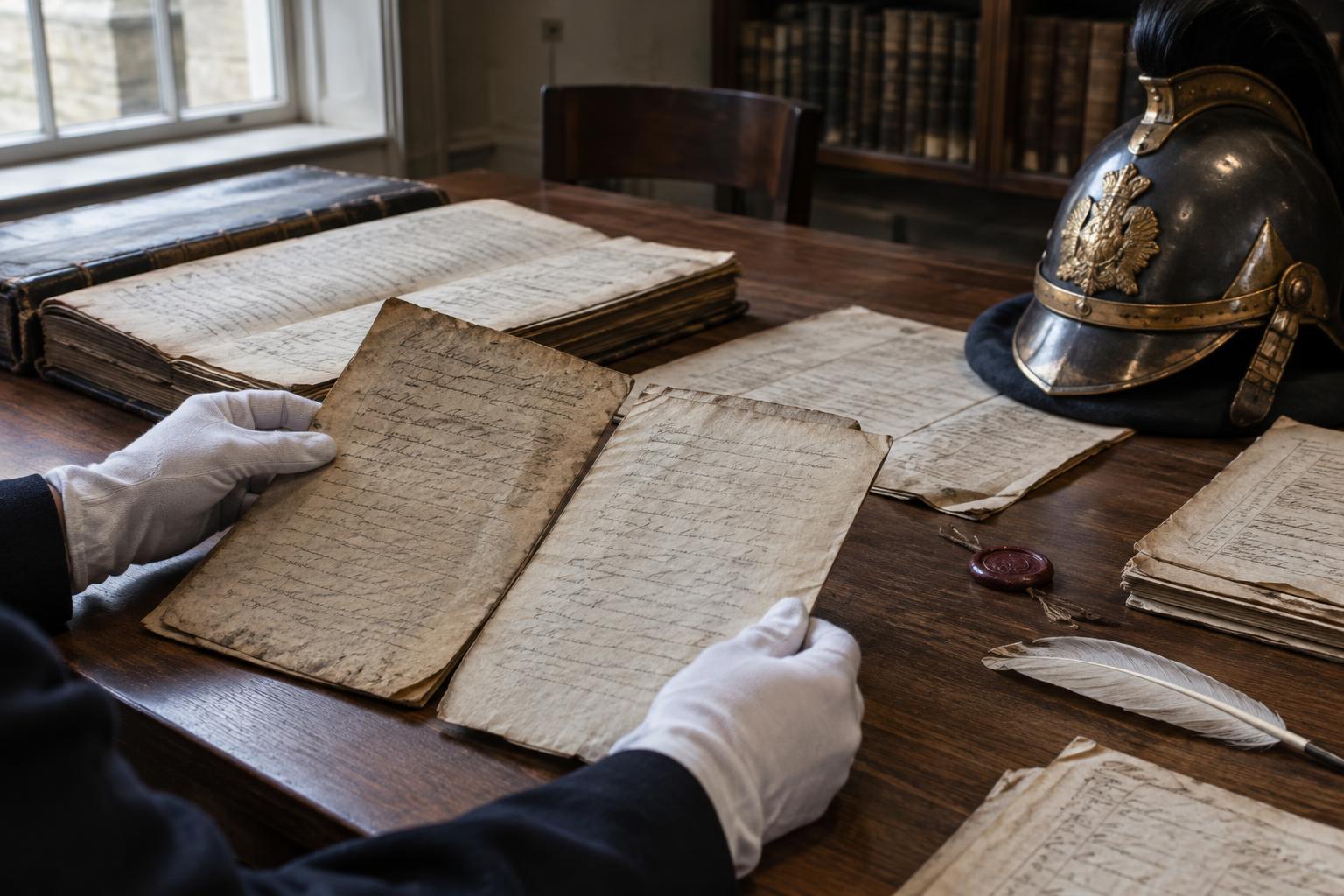
Evidence beyond chronicles may help test a claim, though it rarely supplies a complete alternative narrative. Administrative records can indicate expenses or changes in authority; surviving objects can illuminate the material culture of those involved; landscapes and archaeology may constrain where certain events were possible. Each type of evidence has limits. A displayed weapon, for example, can reveal craftsmanship and later collecting history without proving that it was used in a particular victory.
Keep the claim and the conclusion distinct
A useful way to write about a battle is to separate levels of confidence. “The chronicler presents the encounter as a decisive victory” accurately describes the source. “The encounter was a decisive victory” makes a broader historical claim that needs further support. Where evidence is thin, it is reasonable to say that the result, its scale or its immediate consequences remain uncertain.
Careful reading does not drain a chronicle of interest. Its account of triumph may preserve details about an event while also showing what later writers valued: loyalty, legitimacy, courage or the restoration of order. In a museum or collecting context, that distinction is especially helpful. Objects and texts can be presented together without treating either as a simple illustration of the other. The result is a fuller history of both conflict and remembrance.